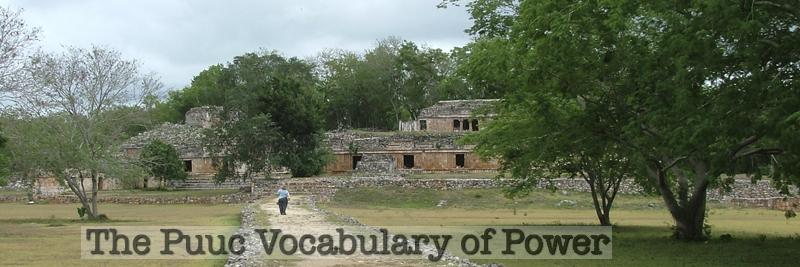
Photo of the sprawling Palace of Labná. If you missed any of the earlier newsletters on El Mirador, Calakmul, or Río Bec, they are available online in the Insights Archive.
The Puuc Network & the Vocabulary of Power
Around 800 AD, the Puuc Hills region of the North/Central Yucatán Peninsula experienced a massive influx of population, driven by elites fleeing the collapsing Classic Maya cities of the South. Palenque, Copán, Calakmul, and Yaxchilan had already gone silent, while Tikal was in its final decline.
As David Stuart, the Mayanist and epigrapher instrumental in decrypting the Maya script, points out, the Puuc population explosion forged a new political culture which recycled the old symbols of the archaic Maya past while expressing the new reality being constructed.
David Stuart, The Four Heavens: A New History of the Ancient Maya, Princeton University Press, 2026, p. 278
Ancient cities of the Puuc
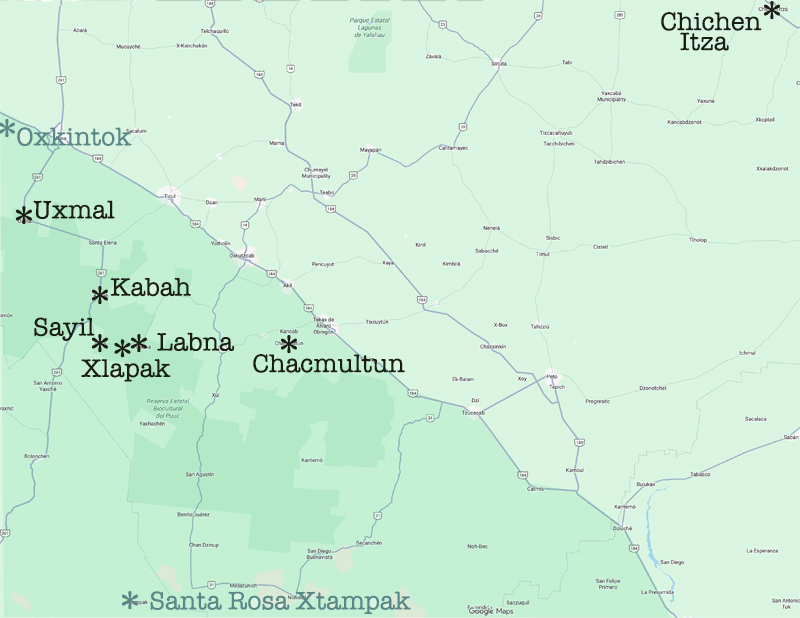
Modern highway 184 runs along the diagonal edge of the Puuc Hills region. Santa Rosa Xtampak and Oxkintok were prominent PreClassic settlements. Click on ruins names to link to that section of the Mayaruins website for additional text and photos.
The Puuc Hills region encompasses western parts of the states of Yucatán and northern Campeche in Mexico. The Late Classic sites here were woven together in a loose confederation by a network of sacbe (white roads) with Uxmal as the central node. David Stuart writes:
The major Puuc centers all have inscribed dates that fall within a remarkably short time span of about sixty years, between about 850 and 910. It was during this time that Uxmal emerged as the most imposing city of all, and shortly after 900 its major architectural monuments were refurbished and constructed in close coordination, including the so-called Nunnery Quadrangle, the Ballcourt, and the final phase of the House of the Governor. The first two buildings have inscriptions that span a very short period from 905 to 907, and all mention a man named K’ahk’bablaj Chanchahk.
This formal name, invoking an aspect of the storm deity Chahk, is a type we have seen many times before [in] the history of the southern lowlands, from earlier generations. I sense that this major ruler, probably Uxmal’s greatest king, was still looking to the Classic past for his “vocabulary” of divinely sanctioned power. His reign may represent a short period of political consolidation around western Yucatán and northern Campeche when Uxmal was a central seat of authority, at least for a short time.
David Stuart, The Four Heavens: A New History of the Ancient Maya, Princeton University Press, 2026, p. 278
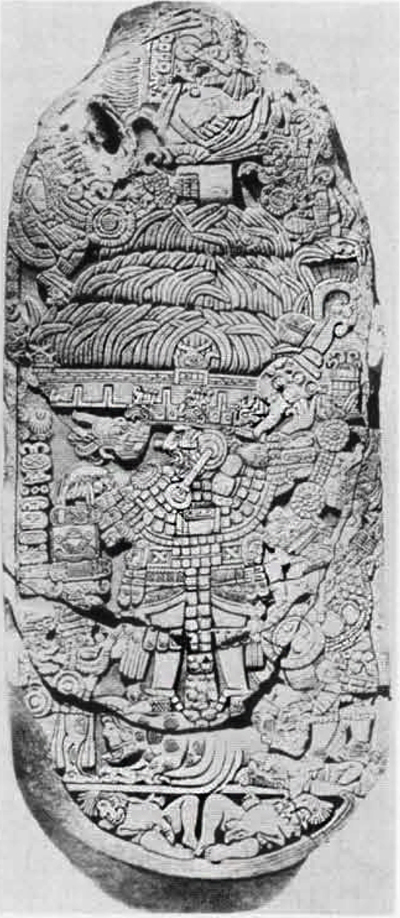
Lord Chac is pictured here on Uxmal Stela 14. He is dressed in antique sartorial splendor, stands on bound captives, wears a bone through his nose, and glowers out from under an opulent feather headress. He is looking toward the left. In addition to his Chac impersonator costume, his full name has now been translated from Stela 14 and appears to have been K’ahk’ Pulaj Chan Chaahk [the same name that David Stuart references above but spelled slightly differently] or “The Chac that Burns the Sky with Fire,” i.e., the storm god of thunder and lightning. His name as well as his Chac impersonator costume leave no doubt that he is presenting himself as a classic Maya “Water King.”
Lord Chac, House of the Governor Central Frieze

Photo by B. McKenzie
Although much fallen away, the personage represented by the central ornament over the central doorway is presumed to be the same Lord Chac as represented on Stela 14. Here he sits within a triangle formed by serpent bars, within which are hieroglyphic inscriptions, some of which pertain to astronomical phenomena. Lord Chac impersonates the storm god of thunder and lightning and generates the frieze's massive volutes of swirling winds which accompany the tropical rainy season. The winds are represented as blowing in clockwise rotation on the left side of the central doorway and counter-clockwise on the right.
Above Lord Chac is a row of Water Serpent masks with water flowing from their jawless mouths. At the top of the frieze is a decorative intertwining snake motif which runs the length of the facade.
Undulating Water Serpent Masks
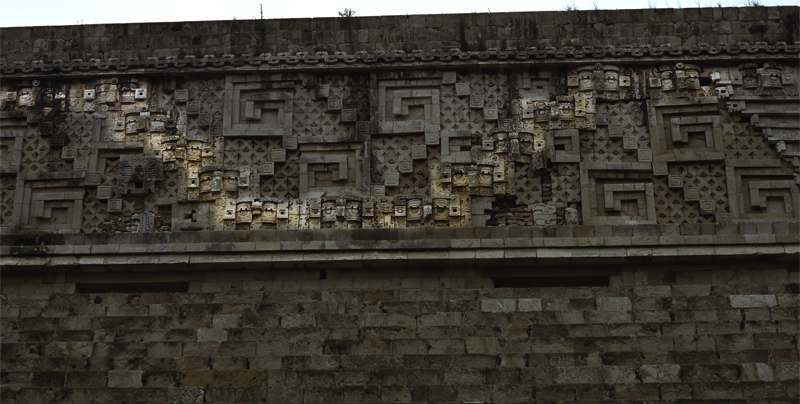
In this photo I have highlighted the undulating snake pattern formed by diagonally stacked Water Serpent masks so that the pattern stands out. Photo by B. McKenzie
The House of the Governor, then, is a dramatic representation of the violent arrival of the tropical rainy season. Diagonal undulating stacks of Water Serpent masks slither across the frieze and curve sinuously through the winds. The diagonal lines of incised squares are referred to as “stepped frets,” which interrupt the wind volutes like sudden strikes of lightning. These diagonals give the frieze an immense sense of kinetic energy and downward motion, perfectly capturing the violence and chaos of the coming rains, while Lord Chac is portrayed as the still center of the storm, commanding the chaotic, swirling energy around him.
sight line for the rising of Venus

Photo by B. McKenzie
The House of the Governor seems to have been designed to serve as an astronomical observatory and was probably connected in some way with the cult of the planet Venus. A bicephalic jaguar throne helps define a sight line for the rising of Venus as Morning Star. The Maya associated the rising of Venus as the morning star with the first rains of the agricultural cycle.
Unlike the roughly north-south orientation of most of the city, the Governor’s Palace faces southeast. A Maya standing in the central doorway in about AD 900, when the building was completed, would have looked across the top of a pyramid three miles distant to the place on the horizon where Venus rose as the morning star at its southernmost declination.
George Stuart, Lost Kingdoms of the Maya p.181
However, unlike the Preclassic El Mirador Basin or later Classic period “Water Kings” who engineered massive hydrology and water management projects vital to the survival of their subjects, archaeological surveys of the Puuc confirm that water storage was heavily decentralized and managed at the household level. Nearly every residential patio group possessed at least one domestic chultun, meaning individual families physically controlled and maintained their own year-round water supply. This stands in stark contrast to the centralized civic reservoirs of Tikal and Calakmul.
Domestic chultun & diagram
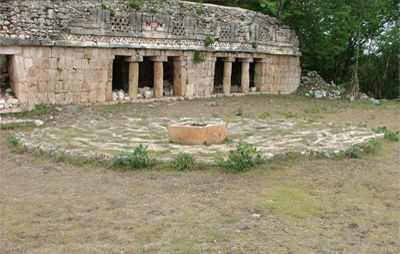

Chultuns at Maya sites stored thousands of gallons of water needed during the dry season and were a part of every Maya household group. The square cube in the center was a modern addition designed to protect the interior of the chultun
Because Uxmal’s ruler did not hold a physical monopoly over the region’s water storage, Lord Chahk’s power as a “water king” operated solely as an ideological and ritual monopoly. Because the common people owned the cisterns, the king positioned himself instead as the religious and shamanic guarantor of the rains.
Thus, Uxmal was primarily a ceremonial city where the religious and charismatic authority of its ruler was the primary source of power, and the degree to which Lord Chac was able to integrate formalized, theatrical ritual into his city planning and architecture, was key. For example, cosmological processes and solstice events are used in building placement to emphasize the ruler’s shamanistic role as custodian of esoteric knowledge and power.
City planning and design framed ever-changing vistas for ritual processions and ceremonies, and the buildings themselves provided stages and platforms to support elaborate ceremony and dance. Acoustical effects were created to enhance public performances.
All of Lord Chac’s buildings use rich iconography to message supernatural power, while the sheer grandiosity of his building campaign unmistakably conveyed his personal power to summon and harness the enormous human labor needed to complete these projects.
Puuc Architecture
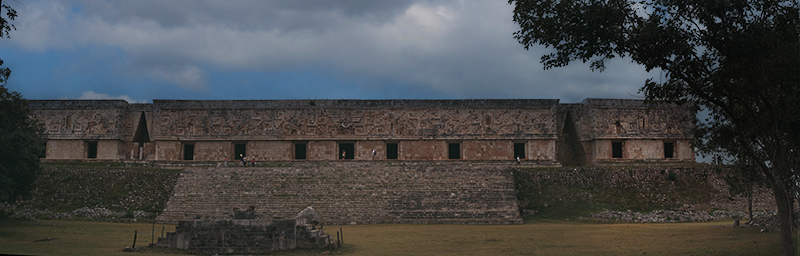
Lord Chac’s Governor’s Palace at Uxmal. The gigantic building is 328 feet long and set on an immense four-tiered platform which rises 50 feet above ground level. It is oriented to face the first rising of Venus as Morning Star, as well as to exhibit solar equinox and solstice events. Photo by B. McKenzie.
Puuc architecture is characterized by long range-type buildings faced with a plain stone veneer extending to the top of the doorways, then topped with wide friezes composed of elaborate stone mosaic patterns. Puuc-style architecture was made possible by innovations first introduced in the Río Bec/Chenes region, where rubble cores faced with thin, well-finished veneer was employed, making possible the attachment of intricate stone mosaics.
Puuc architecture has long been admired by modern visitors. In 1841, the diplomat and travel writer, John Lloyd Stephens, wrote of the Governor’s Palace: “There is no rudeness or barbarity in the design or proportions; on the contrary, the whole wears an air of architectural symmetry and grandeur.”
The Puuc Mosaic Facade
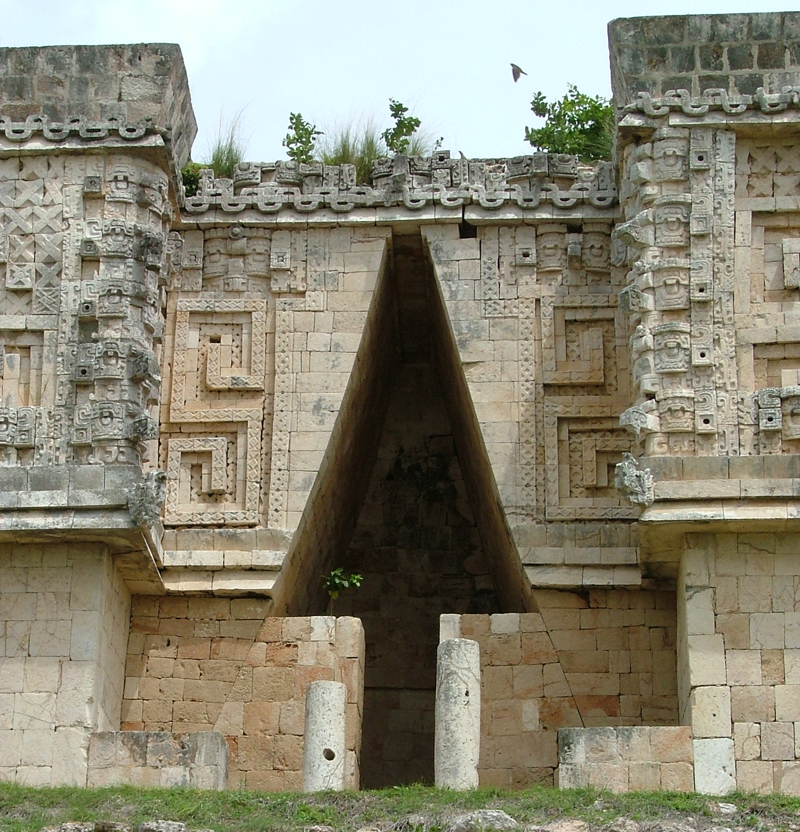
Detail from the Governor's Palace, Uxmal. Five raingod masks are stacked on either side of the opening. Photo by B. McKenzie.
The House of the Governor brings similar responses from art historians and architects, including Frank Lloyd Wright, who considered it the finest example of ancient American architecture. David Stuart, in his new book The Four Heavens: A New History of the Ancient Maya, observes:
The intricate stonework of Puuc facades formed elegant geometric patterns, both simple and complex. On many of the larger structures, we also see front-facing serpent masks, usually over doorways or “stacked” on the corners of buildings. The resulting designs are often stunning and among the most beautiful architectural adornments from anywhere in the ancient world. Their geometry and linework exerted a strong and conscious influence on American architectural design in the early twentieth century, especially in the early works of Frank Lloyd Wright and in the development of the Art Deco style.
David Stuart, The Four Heavens: A New History of the Ancient Maya, Princeton University Press, 2026, p. 280-281.
The Messages of the Masks
Stuart continues, expanding on the theme that the Puuc architectural style was at once both innovative but deeply rooted in ancient designs and iconography:
Repeating “masks” give many Puuc buildings their distinctive look, but we should also bear in mind that they are a part of a long history of “messaging” on Maya architectural facades, reaching far back to the Late Preclassic.

Photo by B. McKenzie.
Their mosaic stonework reflects a relatively late technique, at sites such as Uxmal and Kabah, but earlier examples can be found at many Maya centers. Their direct antecedents are the many serpent masks we find in the Chenes and Rio Bec region near Calakmul and Dzibanche. And those, in turn, have clear precedents in some of the representations of serpents we find in Classic and even Late Preclassic iconography. Many have interpreted the Puuc masks as the rain deity Chahk, whereas others emphasize that they may have the faces of mountains. My own view is that most of these animate faces are representations of the “Water Serpent,” a dragon-like character whose forehead was adorned with a waterlily pad and flower. Vestiges of these diagnostic features appear with regularity, enough to show a strong connection to earlier, more obvious forms. These formal public buildings and temples were marked with the Water Serpent because, simply put, the Maya of Yucatán and the northern peninsula were rightly obsessed with water and its procurement. Water may well have been one of the bases of royal power among the late north Maya, building on a very old ideology we can track a thousand years earlier.
David Stuart, The Four Heavens: A New History of the Ancient Maya, Princeton University Press, 2026, p. 280-281.
Iconography of the Water Serpent
David Stuart was an epigrapher instrumental in the decryption of the Maya glyphs, and was the first to established that the so-called “God B” was the rain god and in fact actually named Chac. However, the Water Serpent is distinct from Chac/God B because it is not a personified god but rather a personification of an impersonal force of nature. Stuart’s arguments about the identity of the Water Serpent is given in his short notes about the Imix glyph [see his Day Sign Notes: Imix / Imox and also Reading the Water Serpent as WITZ’]. Stuart believe that many of the masks at Uxmal, collectively identified as representing Chac, the Sky God of Thunder and Lightning, are really diagnostic of the Water Serpent instead, which is the personification of terrestrial bodies of water, i.e., cenotes or arroyos, lakes and rivers. He writes:
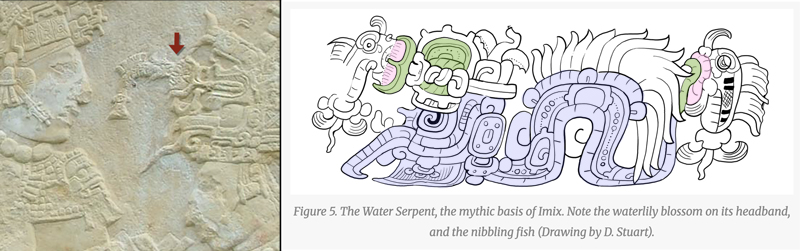
Photo on left: fish nibbling the waterlily motif, from Bonampak Stela 2. Drawing on right: Stuart's drawing of the Water Serpent.
This is the so-called Water Serpent (or Waterlily Serpent), as first observed by Eric Thompson. Thompson first referred to this being as the “Imix Monster” which later came to be called the “Lilypad Headdress Monster,” the “Waterlily Monster,” the “Waterlily Serpent,” or, as I prefer here, simply the “Water Serpent.”
The Water Serpent shows several distinct features, among them a waterlily pad at the forehead, a blossom tied to its front, and a fish biting or sucking at the flower. Often the same fish is shown biting or sucking at the tail of the serpent. Its fishy dorsal “fin” evolved over time to be shown as elongated long quetzal feathers (that is, it came to be a “feathered snake” of the water, probably also a conceptual relation or antecedent to K’uk’ulkan). Its body can simply be the undulating water band. This important iconography has been most recently [investigated] by Coltman, who examined its many connections in Mesoamerica, well beyond the Classic Maya world. In ancient Maya mythology this being was the primordial snake (naahkan) that was the essence of water, and who oversaw the creation and raising of the earth...
David Stuart, The Four Heavens: A New History of the Ancient Maya, Princeton University Press, 2026, p. 280-281.
Note: I am intrigued by the possible relationship between the Maya Water Serpent and the Horned Serpent of indigenous North American folklore, a mythical, dragon-like creature with a snake's body and horns, marked by iridescent scales and a divination crystal in its forehead. It is associated with lakes, rivers, deep caves, rain, and thunder. Horned serpents are viewed as powerful, sacred beings of wisdom and healing, but also capable of great destruction and chaos.
Water Serpent Iconography
Kowalski, House of the Governor, p. 182-183
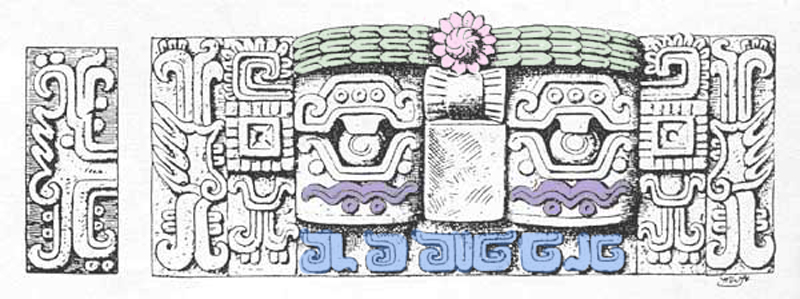
Vestiges of Water Serpent symbolism are prominent in the masks decorating the frieze of the Governor's Palace at Uxmal. All wear leafy headbands decorated with a waterlily flower attached at the center, and water flows from their jawless mouth. Furthermore, the masks wear Venus symbols under their lower eyelids (marked in purple here), underscoring the fact that the central door of the Governor's Palace is oriented to the first rising of Venus as the Morning Star, a celestial event which marked the beginning of the rainy season in Yucatán. Perhaps most telling, however, is that the Water Serpent masks are arranged in an undulating diagonal pattern which snakes across the entire length of the House of the Governor's facade, thus reinforcing their identity as water serpents.
Gallery: Water Snakes, Chacs, & Witz Monsters
At one time, everything in the Puuc Hills region with a long nose was called a “Chac mask,” but more recently scholars are differentiating the various instances of these masks and working out their distinct roles and identities.
We have defined the distinct iconography of the Water Serpent and taken a cursory look at the Chacs, but the seemingly endless variations of these themes across Puuc architecture is everywhere apparent. Because the visual traits of these mythological players frequently overlap, their exact identities often remain murky.
Gallery of Puuc “Long Nosed Masks”
Here is a small gallery of masks from the Puuc Hills for your enjoyment, contemplation, and identification. Alongside the Water Snakes and Chac rain gods, there are even some Witz Mountain Monsters derived from the Río Bec “Monster Mouth” temples.
Masks from Governor's Palace, Uxmal

Photo by B. McKenzie.
Three-quarter view of the gigantic Venus-marked Water Serpent masks present everywhere on the House of the Governor. Note the especially well-preserved waterlily blossom on the headband of the upper mask as well as the water pouring out of a jawless open mouth.
Mask Stack from Nunnery Quadrangle, Uxmal

Photo by B. McKenzie.
The four circles at the top of this tower adorning the North Building of the Nunnery Quadrangle is a hard-to-recognize Tlaloc figure, the central Mexican (non-Maya) rain god. The top two circles are his google-eyes, the lower are ear spools, and his mouth is framed with what looks like a mustache. He has a Venus sign of interlocking triangles under his chin.
Underneath Tlalok is a stack of what I would guess are genuine Maya Chac Rain God masks, which are distinguished from Water Serpent masks because:
- They lack the waterlily flower in their headbands
- They have a prominant lower jaw with teeth, and a somewhat humanoid mouth (Chac was portrayed as a god with a semi-human form), compared to jawless Water Snakes which represented forces of nature whose bodies were waves of flowing water resembling snakes and whose jawless mouth gushed with flowing water.
- Chacs, as well as Witz Mountain Monsters, have snakes or forked tongues emerging from the sides of their mouths (most visible on the left side of the bottom-most mask).
A Giant mask on the frieze of the Palace of Sayil

Photo by B. McKenzie.
Because of its placement above a columned entrance of the Palace of Sayil, and also because of the prominance of its upper teeth, I would guess that this is an adaptation of the Monster Mouth Temples of the Chenes/Río Bec region (featured in our last newsletter), and therefore closely related to the Witz Mountain Monsters. An interesting side note: at one time, some scholars even classified all long nosed Puuc masks as “Witz Monsters.”
The Codz Poop at Kabah
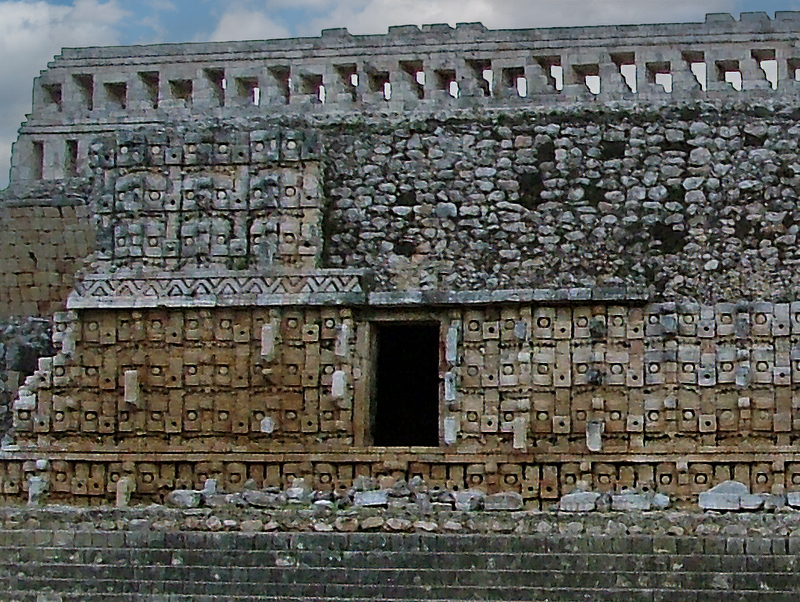
The Codz Poop at Kabah, west side. Photo by B. McKenzie
The Codz Poop is unique in that its entire surface—foundation, walls, and frieze—was once covered with long nosed masks. It is hard to know how many originally composed the facade, but scholars estimate that there likely were 365 masks, one for each day in the solar calendar. The masks align perfectly both horizontally and vertically, with the foundation masks slightly out of phase so they align perfectly under each doorway. The ric-rac edging at the bottom of the frieze is said to represent the undulations of a snake (or perhaps flowing water).
Masks serving as steps at Codz Poop give a closer look

Masks on the foundation serve as stairs into rooms. Photo by B. McKenzie.
A closer look at a Codz Poop mask serving as a step into one of the rooms gives us more detail to work with. Each mask has a bottom jaw with a small snake at the corners, and lacks a well-defined waterlily attached to a headband. For these reasons, I probably would guess that all 364 masks on Codz Poop are genuine Chac rain god masks.
Mask stack at the Puuc Palace of Labná

Photo by B. McKenzie.
This is one of my favorite mask stacks in all of the Puuc Region. I love the ancient wild eyes of what I think are probably Water Serpent masks, based mainly on the fact that they have no lower jaws and water pours from their ample mouths. The absence of visible waterlily flowers in their headbands can perhaps be accounted for because they are hidden under the large overhanging noses.
“Palace” of Xlapak, NE corner

Photo by B. McKenzie.
A good example of the process of simplification, of extreme “geometrization,” which many of these masks underwent then, can be seen on the Palace at Xlapak, where they adorn large ornamental panels that highlight the roof level both at the corners and over the central doors.
Gendrop, Paul. Rio Bec, Chenes, & Puuc Styles in Maya Architecture. Labyrinthos Press. Lancaster, California 1998, p. 180-1
Note that even though the masks are highly abstracted, the waterlily flower attached to the forehead can be clearly seen on the middle mask. However, this mask stack also reveals mixed identities: while the waterlily flower—a diagnostic of the Water Serpent— is prominently retained on the headband, it combines with a distinct lower jaw and emerging snakes, which are classic features of Chac or the Witz monsters.
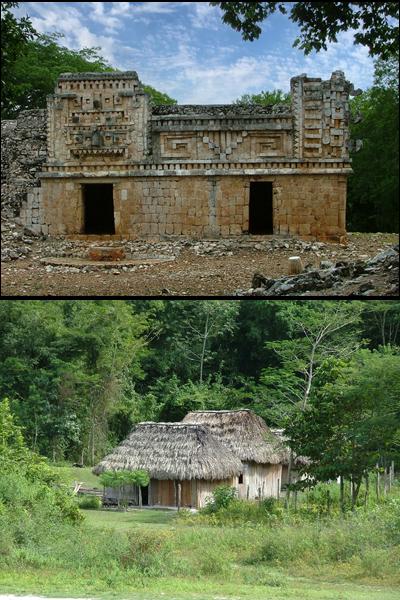
While paramount rulers like Lord Chac used colossal architecture and archaic symbolism to project god-like authority, the reality on the ground was more nuanced. Extensive settlement surveys across the Puuc reveal a surprising number of high-quality, stone-vaulted residential complexes scattered throughout the region. These vaulted stone houses were orders of magnitude more costly than traditional Maya houses, and the sheer volume of these non-royal estates proves the existence of a robust, prosperous tier of “intermediate elites”—minor nobility, merchants, and wealthy agricultural estate managers who controlled a significant portion of the region’s wealth.
Note the small domestic chultun in the platform of the stone residence
The iconographic mixture seen on the mask stack at Xlapak may reflect the economics of construction among the prosperous Puuc middle class. As architect Paul Gendrop has noted, fully developed Puuc architecture relied heavily on standardized mosaic elements that were essentially “mass produced” in local stone-finishing workshops. Without the strict theological oversight commanded by a paramount ruler like Lord Chac, local elites and landowners likely assembled these “off-the-shelf” architectural elements more freely. At Xlapak, the result seems to have been a localized, budget-conscious architecture where the strict visual boundaries between Water Snakes, mountains, and rain gods begin to blur.
Comments? Questions? Let us know at newsletter@mayaruins.com
Our OCT/NOV 2026 Issue, Kukulkan & the Cenotes of Chichén Itzá, explores Chichén Itzá’s architectural serpents and their symbolic descent into the watery underworld of the Sacred Cenote.
NOTE: Visit our ARCHIVE for past newsletters.