
Chacmultun means "mounds made of red stone" in Maya.
H.E.D. Pollock, working under the auspices of the Carnegie Institution, visited Chacmultun in the late 1930's. He writes:
The outstanding characteristic of Chacmultun...is the utilization of natural eminences to locate the city's important civic and religious structures. The buildings tend to face one another, but, and perhaps more importantly, they focus on the floor of the valley that bisects the site. One is tempted to conjecture the presence of some important precinct or structure on the valley floor. In any event, lack of knowledge of this central part of the city is a handicap to understanding the overall plan.
The name Chacmultun applies specifically to the group of buildings in the northwest part of the ruins, but has been extended to include the whole site. The three groups which constitute the major ruins at the site are known as the Chacmultun Group, the Xetpol Group, and the Cabalpak Group.
Map of the Chacmultún Ruins

Map adopted from H.E.D. Pollock: The Puuc Architectural Survey, Peabody Museum 1980.
Click on GREEN ARROWS to view photos of major buidings, or on links for building diagrams.
See our Chacmultún reading list.
To see Edward Thompson's 1904 archaeological notes and building diagrams, please click on these links: Edifice 1, Edifice 2, Edifice 3, Edifice 4 and Edifice 5
Edward Thompson, Archaeological Researches in Yucatan. 1904: p. 13-16
Chacmultún Group: Edifice 3

Entering the Chacmultún Group on February 16, 1997 with Edifice 3 in front
Edward Thomson, an early Mayanist who explored and mapped this site in the early 1900's, translated the name Chacmultun as "red-stone hills". The red color of the building stone has been attributed to bacteria living in the limestone which turns red when exposed to air. The Chacmultún group is notable for its extensive terracing. At the south and east the lower terrace is faced with cut stone, as can be seen to the left in this photo.
(Pollock, p. 362)
Bldg of the Paintings

This building is known as the "Building of the Paintings", notable for mural paintings which were first described and copied by Edward H. Thompson around the turn of the century. The surviving but badly damaged murals in room 10 were done on two horizontal strips which run along the upper third of one wall, and illustrate a ceremonial procession.
The caretaker's booth

The caretaker at Chacmultún very kindly showed us this copy of Thompson's 1899 drawing and allowed me to photograph it in natural light. The INAH brochure for the site describes the murals as follows:
"All of its vaults were painted inside and out in various colors, with emphasis on red and blue.
The surviving mural painting in one room depicts scenes with chieftains placed on low horizontal strips which run along the upper third of one wall. They are all walking barefooted and their clothing is limited to loin cloths and several kinds of headdresses, plus adornments such as noseplugs, earplugs, necklaces, and breastplates.
In their hands they grasp lances, lance throwers, trumpets, parasols, feather adornments, and other, unidentifiable objects. Other elements placed at both ends of the painting appear to be thatched roof buildings."
Chacmultun, Yucatan, Instituto Nacional de Antropologia e Historia, 1991
Thompson's Bldg V Murals
Edward Thompson's 1899 drawing of the murals in Building V, Room 10:


All of its vaults were painted inside and out in various colors, with emphasis on red and blue. The surviving mural painting in one room depicts scenes with chieftains placed on low horizontal strips which run along the upper third of one wall. They are all walking barefooted and their clothing is limited to loin cloths and several kinds of headdresses, plus adornments such as noseplugs, earplugs, necklaces, and breastplates.
In their hands they grasp lances, lance throwers, trumpets, parasols, feather adornments, and other, unidentifiable objects. Other elements placed at both ends of the painting appear to be thatched roof buildings."
Chacmultun, Yucatan, Instituto Nacional de Antropologia e Historia, 1991
1997 murals vs 1899 drawings
Comparison of Thompson's 1899 drawing:

...with the damaged original in the Chamber of the Paintings

Although the murals are in very poor condition, some details can still be discerned. I have outlined those parts of the mural that I can make out in red on Thompson's drawing (above).
Thompson's drawing is an invaluable source of information, but his drawing does not do justice to the original. Look, for example, at the beautiful lines defining the bend of the knee and calf in the figure to the right.
This photo of the mural was taken in natural light without flash, and was enhanced in Adobe Photoshop.
Back of the Palace Platform

We then walked east and north to explore the back of Edifice 1, "The Palace". The area behind the Palace is very rough and full of rubble, and the platform upon which it was built falls away precipitously.
This is Marion, who is the brains behind the planning and execution all of our trips. Hats off to Marion!
Dislocated masses of masonry

The left wing of the palace has been reduced to dislocated masses of masonry. In this photo it is easy to see how Puuc construction techniques utilizing interior rubble fill surfaced with well cut plain and mosaic stonework was used to build the Palace at Chacmultun. These are very solid buildings.
Edward Thompson, the early explorer of Chacmultun, comments dryly: "The extreme left wing is also reduced to dislocated masses of masonry."
Ruined arches and overturned vaults

Ruined arches and overturned vaults characterize the back of the palace. The Maya arch lacked a keystone at the top and instead used L shaped "boot stones" to redistribute weight and keep the sides of the arch from collapsing inward. This type of arch was topped by a capstone, the flat stone joining the sides of the arch at the top.
Glyphic inscriptions and small paintings often decorate the capstones of interior vaulted rooms, and ancient graffiti is often found on the sides of vaults, although I am not sure any have survived at Chacmultun.
Main entrance of Palace

The main entrance of the Palace features a grand stair and gorgeous column work. Thompson continues:
A wide, well-made stairway on the south connects with the tier of chambers below, in the first story of the Palace edifice. In this first story some of the chambers are double, and several have handsome corridors with circular pillars instead of plain sustaining-walls. This, as will be seen by reference to the photograph, gives a pleasant artistic effect to the whole front.
E. Thompson, "Archaeological Researches in Yucatan" 1904: p. 11-13
Second Story Niches
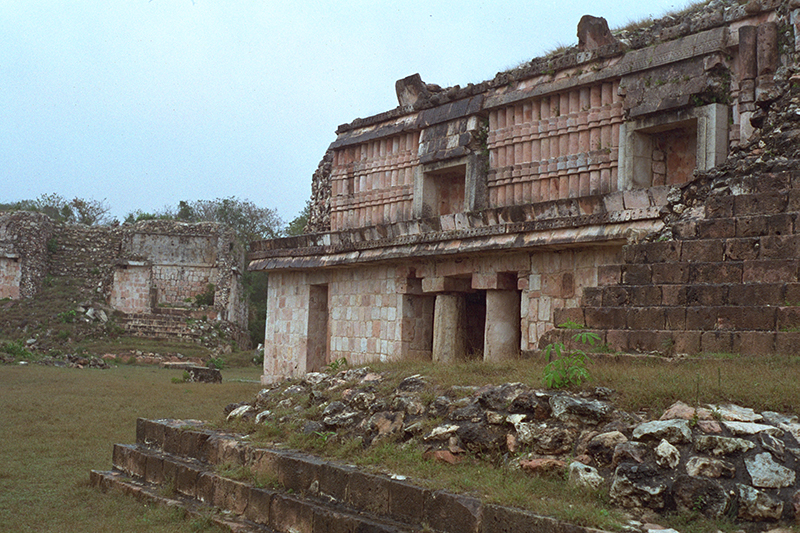
The second story features niches in the form of Maya hut. Thompson continues: "At regular intervals are niches in which were once placed stone figures which were undoubtedly pregnant with religious meaning."
Also called The Palace of the Phalli

Detail of hut-type niche in west façade. This motif, also seen at Labná and Uxmal, is a standard Puuc decoration. Because of the stone phalli projecting from the cornice moulding, this building is also called the Palace of the Phalli.
Western extension of the Palace
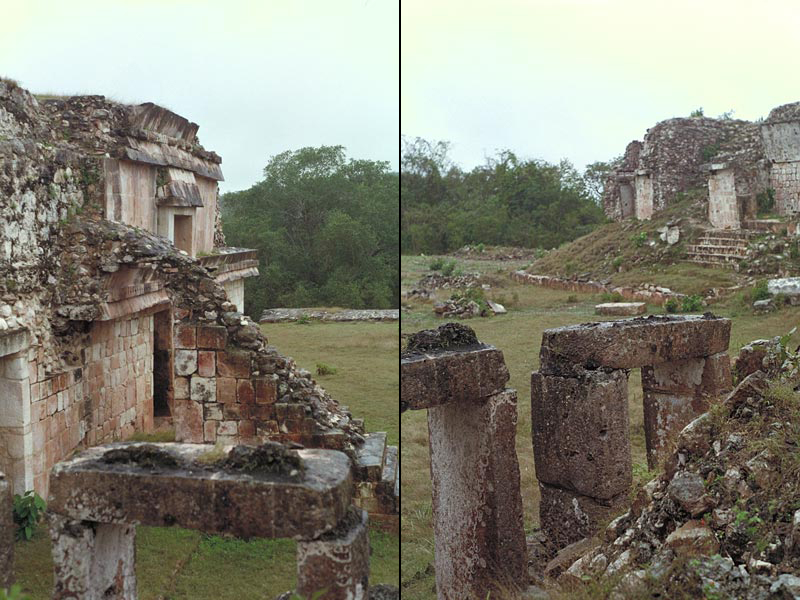
Two photos taken from the mound of rubble which constitutes the "western extension" to the palace. In the foreground of both photos are the still erect doorjambs and lintels from this extension.
Left: West side of palace showing vaulted passage under the stairs.
Right: Looking toward Building II, which Teobert Maler fancifully named "The Chamber of Justice".
Arch under the western staircase

Looking through the arched passageway under the staircase toward the ruined western extension to the palace. A still-intact doorframe with a bit of medial moulding is visible in the background, and frames the remains of a collapsed vault.
The stairway arch

This is our Maya friend Manuel, standing under the stairway arch. Manuel planned and accompanied us on our visit to Chacmultun.
Portrait of our Friend Manuel

Manual and Marion worked together to organize this unforgetable day at the ruins.
Western extension of the Palace

On the left is an extension to the palace which is mostly in ruin, but the doorframes and lintels of some rooms are still intact. Also visible on the foreground wall are fragments of a three-member medial moulding matching that of the main part of the palace.
Chultun at the side of palace

There is no permanent supply of water in the area, so underground cisterns were used to collect and store water for use during the dry season. This one in front of Edifice 2 was identified by Edward Thompson, and there were undoubtedly many others in the area.
Manual climbed up the ruined staircase because he wanted to inspect the second floor architecture at close range.
The Palace
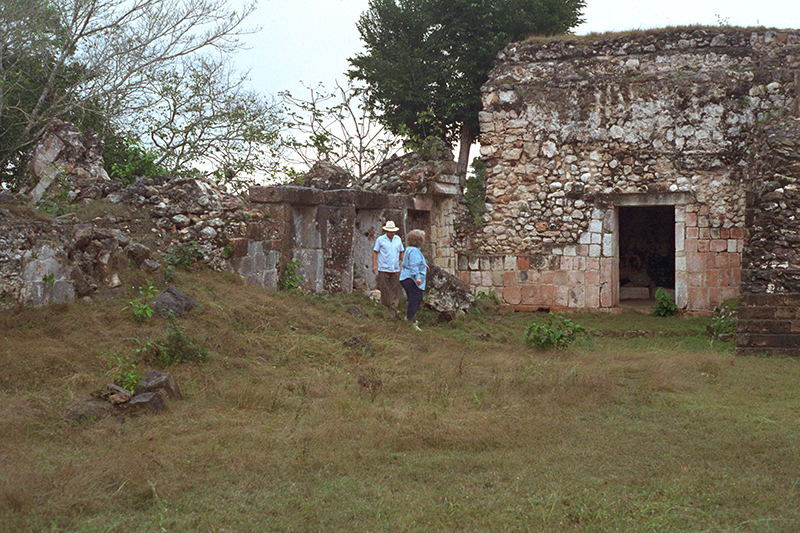
Looking toward Edifice 2

Edward Thompson, an early explorer at Chacmultun, writes: "Edifice 2 is a small structure, built, as will be seen by reference to the general plan, upon the same general terrace, but at a slightly lower level than that of the Palace.
Its front, now almost entirely fallen, presents no visible detail of interest. Its central core is so extraordinarily thick and massive that one is almost irresistibly led to believe, with the treasure seekers before mentioned, in the existence of a hidden chamber within its space.
Due investigation proved this to be an illusion. The core, or hearting, is a solid mass of rubble work, large masses of rock being used as material. I believe that this unusually massive core was the preliminary work to the erection of a second story that for some reason was never carried out."
E. Thompson. Archaeological Researches in Yucatan. 1904, p. 13
Edifice 2

PPollock fancifully name Edifice 2 "The Courthouse"; Teobert Maler called it "The Chamber of Justice". This building is characterized by a very unusual recessed staircase which goes from the level of the plaza to the top of the building. It is flanked by the remains of two vaulted rooms which were added after the main platform and the stairway were built. The photo also shows the debris of small platform in the foreground.
Burial vault inside west wall

H.E.D. Pollock mentions a burial vault embedded in the back (west) wall of this building. Three large steps lead from the entrance level to the floor of a "long-buried" vault (not shown). An opening several feet off the ground leads to a narrow passage that make a 90-degree turn to the right, goes up some steps, then turns straight almost to the south end of the building. Pollock remarks incidentally that the vault is crudely built.