Chicanná: Central Plaza Map


This map is a detail from Jack Eaton's Chicanná site map. Click on GREEN ARROWS to view photos of major buildings, or just scroll down. See our Chicanná reading list.
Structure II, defining the east side of the Central Plaza, is the most perfectly preserved monster-mouth temple in existence as well as the most spectacular and famous building at Chicanná.
Jack Eaton, the discoverer of Chicanná, describes the Central Plaza group as two standing and two collapsed structures enclosing a rectangular plaza with interior dimensions of about 35 by 50 meters. He goes on to say that the Late PreClassic occupation probably dates from between A.D. 150 and 250, so this site has a long history of being settled. Much later, a subsequent flooring was built during the Late Classic period, probably between A.D. 650 and 750, which is probably the date of the current plaza and the buildings that we see today.
Eaton, Jack D. "Chicanná: An Elite Center in the Rio Bec Region", in Preliminary Reports on Archaeological Investigations in the Rio Bec Area, Campeche, Mexico. Middle American Research Information, Tulane University. New Orleans 1974, p. 133
Structure II

Photo by B. McKenzie.
Structure II is the most beautiful & well-preserved monster mouth temple anywhere. The central door of the temple represents the giant maw of Itzamna, the reptilian creator god "who imbibes or swallows". Itzamna looks out with spiral eyes set in rectangular sockets and shows a formidable row of teeth which span the doorway. For a hi-res photo, click here.
Inward facing serpent masks bracket the doorway beneath the central Itzamna figure, bearing open mouths lined with teeth. A raised platform, extending from the central doorway across the front terrace to the staircase, is also lined with up-curving teeth, which appear to represent the lower jaw of the open-mouth doorway. Four superimposed, abstract serpent profiles finish the outer edges of the central decorative panel.
)
Fractal iteration of serpent motifs

Photo by B. McKenzie.
The almost fractal iteration of the stylized serpent motif comprises the main design.
In addition to the repetition of the serpent motifs at different scales which decorate the central portion of the building, Jack Eaton writes that most of the wall surfaces were painted red, but that parts of the façade still retained traces of green, blue, yellow, black, and white paint. This building must have been an extraordinary sight in A.D. 750.
Buildings with monster-mouth doorways are found not only in the Rio Bec and Chenes regions, but also in the Puuc region: for example, El Adivino at Uxmal; on Las Monjas at Chichen Itza; and also on Temple XXII at Copan, Honduras.
The styles vary greatly from region to region, as does the basic architecture. This suggests a common Late Classic religious decorative theme implemented by architects with widely differing construction traditions and techniques.
Eaton, Jack D. "Chicanná: An Elite Center in the Rio Bec Region", in Preliminary Reports on Archaeological Investigations in the Rio Bec Area, Campeche, Mexico. Middle American Research Institute, Tulane University. New Orleans 1974, 134
Interestingly, ancient graffiti — erased today — was found in the central room of this structure. It portrays Itzamna entering the Rio-Bec style temple across the courtyard as well as a Tikal style temple-pyramid unfurling its standards and sunshades.
abstract panels of profile serpents

Photo by B. McKenzie.
These abstract profile serpent masks which border the main mask are common everywhere at Chicanná (for example, see Structure VI and Structure I), as well as across the whole Chenes/Rio Bec region. They make lovely design elements and elegant borders, so no wonder the ancient architects loved them.
Remnants of red painted glyphs

Photo by B. McKenzie.
The remains of red painted glyphs to the right of the central door were revealed in 1986 when a layer of stucco which had covered them fell off of the building.
Traces of original paint

Photo by B. McKenzie.
Traces of red, blue, green, & yellow suggest the building was once brightly painted.
The north and south wings of the building are plain in design. Although the upper part of the south wing has fallen, there is little doubt that it was identical to the north wing.
Stone slabs, which supported figures of humans and mythical creatures, project from the upper façade all around the building. The roof originally supported a narrow, stucco-decorated roof comb, now mostly fallen.
Traces of paint on remaining plaster suggest that most of the wall surfaces, including the roof comb, were painted red, with accents in blue-green and yellow."
Eaton, Jack D. "Chicanná: An Elite Center in the Rio Bec Region", in Preliminary Reports on Archaeological Investigations in the Rio Bec Area, Campeche, Mexico. Middle American Research Institute, Tulane University. New Orleans 1974, p. 135
Smaller doors frame main entrance

Photo by B. McKenzie.
The doorways at each end of the building are represented as thatched Mayan huts. This motif is common in Puuc architecture as well, and examples may be seen at Uxmal, Labná, and elsewhere.
Doors had built-in cord holders
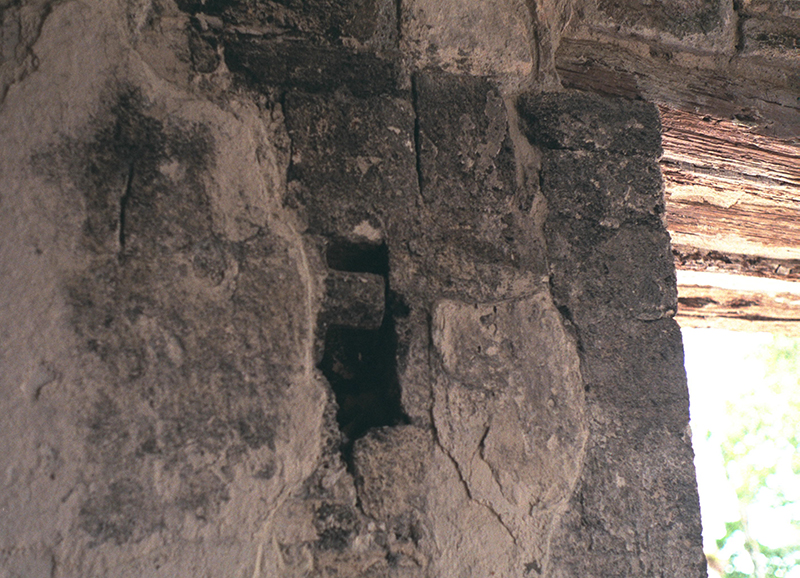
Photo by B. McKenzie.
Looking toward the central doorway from inside Structure II, one can see the still-intact wooden lintel over the door as well as a cord holder used to tie up curtains. The Maya used woven fabric to partition off areas of a room or to cover external doorways.
One can imagine the riot of color which bright fabrics likely provided, especially combined with the brightly painted exterior of the building.
Construction details
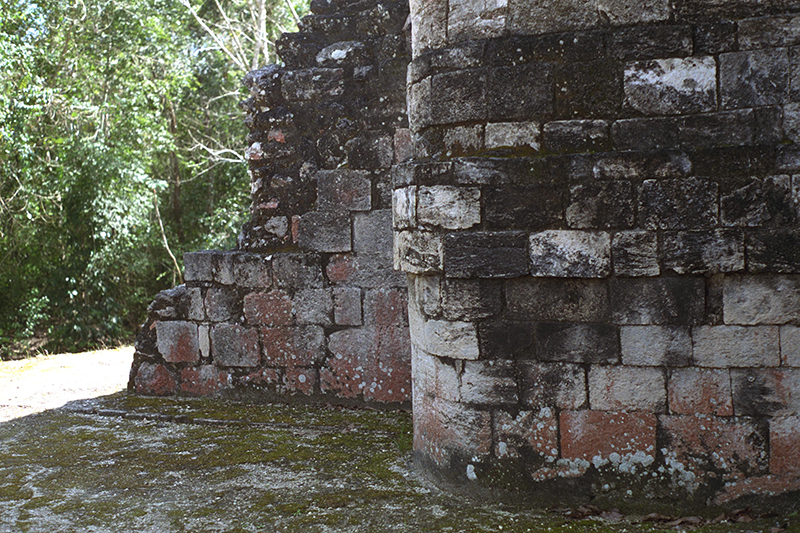
Photo by B. McKenzie.
Regarding the foundation of this building, Jack Eaton remarks:
The masonry of this building is similar to that of Structure I and seems to be within the same basic tradition. The foundation walls are set directly on bedrock, forming enclosures filled with dry-laid gravel, topped off with a good hard-plaster flooring. The walls of the superstructure rest upon these foundations; thus, the terrace consists of nothing more than external retaining walls filled to below-room floor level with dry-laid gravel and finished with a plaster flooring."
Eaton, Jack D. "Chicanná: An Elite Center in the Rio Bec Region", in Preliminary Reports on Archaeological Investigations in the Rio Bec Area, Campeche, Mexico. Middle American Research Institute, Tulane University. New Orleans 1974, 135
The Back of Str II

Photo by B. McKenzie.
The back of Structure II reveals collapsed vaults and triparte room layout.
The rooms in this building are large. A raised bench is at each end of the front rooms, and each inner room has a single raised bench covering most of the floor space. The smaller end rooms have benches on two levels, the innermost being the higher.
Charcoal and incised graffiti literally cover all remaining wall plaster in the rooms. The graffiti include illustrations of humans, many of whom are wearing elaborate costumes; various animals; serpents; imaginary monsters; and buildings. Most of the buildings depicted represent stepped pyramidal structures, surprisingly similar to structures at Tikal."
Eaton, Jack D. "Chicanná: An Elite Center in the Rio Bec Region", in Preliminary Reports on Archaeological Investigations in the Rio Bec Area, Campeche, Mexico. Middle American Research Institute, Tulane University. New Orleans 1974, 135
Theatrical monster-mouth Façade
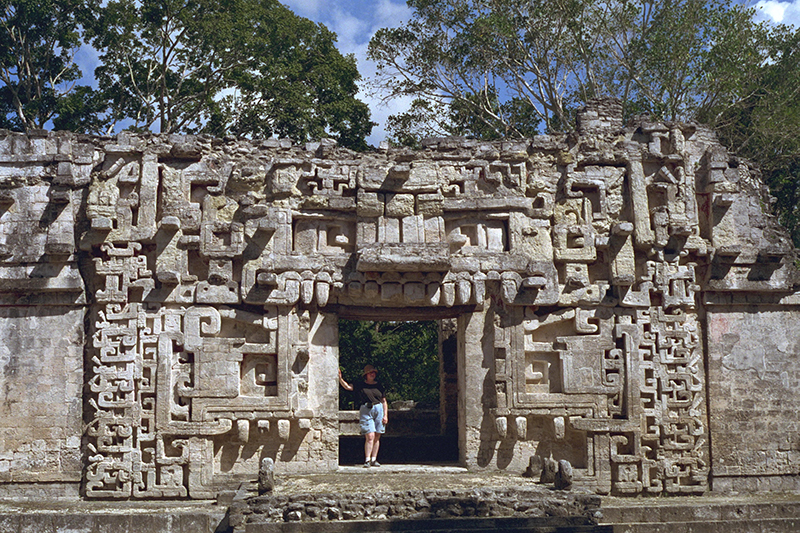
Photo courtesy of Marion Canavan.
This is me, posing for a last photo in the monster mouth at Chicanná. A colleague at work suggested I use an animated ".gif" to wave or doff my hat, but unfortunately this picture will have to remain low-tech for a bit longer.
Structure III was elite residence

Photo by B. McKenzie.
In 1974, Jack D. Eaton, the discoverer of Chicanná, described Group A as consisting of two standing and two collapsed structures. Structure III counted as one of the collapsed structures, but was consolidated and restored in the 1980's by Román Piña Chan and Ricardo Bueno Cano.
Terminal Classic, later than Str I & II

Photo by B. McKenzie.
This structure is believed to have been an elite residence built in the Terminal Classic period, making it a somewhat later construction than Str. I & II. Structure III probably had a perishable roof of thatch rather than solid masonry vaults. It has two doorways facing the plaza, and additional entrances from the east and north.
Str I: Rio-Bec style temple
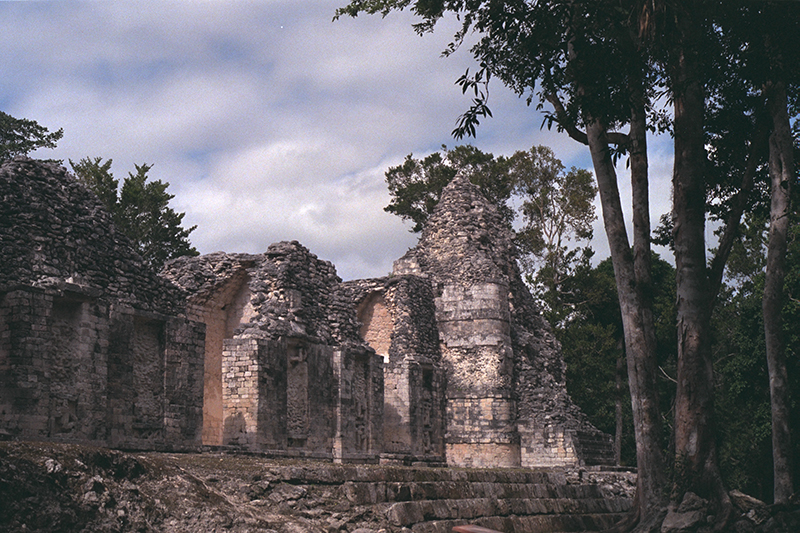
Photo by B. McKenzie.
Structure I is a typical Rio-Bec style temple with a pyramid/tower at each end.
This is a one-story, ten-room building with a broad front terrace and staircase facing east onto the plaza. The building is oriented about 10 degrees east of true north. It has three front doorways and two end doorways. Each doorway leads to a set of outer and inner rooms, and the building plan is quite symmetrical. The front façade is decorated by four ornate panels, each depicting monster mask profiles."
Eaton, Jack D. "Chicanná: An Elite Center in the Rio Bec Region", in Preliminary Reports on Archaeological Investigations in the Rio Bec Area, Campeche, Mexico. Middle American Research Institute, Tulane University. New Orleans 1974, 134
ornate abstract serpent panels

Photo by B. McKenzie.
The front façade of Structure I is decorated by four ornate panels, three of which are visible in this photo. Each panel depicted highly conventionalized monster mask profile stacks. The panels presumably once filled their respective niches and now the rough stone fill above the design shows where archaeologists consolidated and stabilized the building.
Closeup of left panel

Photo by B. McKenzie.
Closeup view of abstract serpent panels seen on the left side of the photo above. There are two serpent masks in this photo, one underneath the other. The serpents face toward the right with their eye in the upper left square area. A long nose descends to the lower right side, and a small forked tongue or fang can be seen inside the mouth. These panels have lost the finishing stucco coating which gave definition and detail to the pattern.
Similar abstract serpent motifs can be seen at Structure VI at Chicanná and at Hochob, at Xpujil, and many other places. Even though these serpent motifs are extremely abstract, with a little practice the eye can be trained to make out the general pattern.
Rio-Bec towers with false temples

Photo by B. McKenzie.
Structure II originally had two Rio-Bec style towers supporting small false temples.
The two end towers of Structure I are round cornered, are stepped, and had steep, nonfunctional, front staircases. Bottom steps from the original staircase can be seen to the left at the base of the tower. Each tower once supported a small false temple on its top. These Rio Bec style ornamental towers appear to be small nonfunctional copies of pyramid-temple structures at Tikal, roughly 140 km. south of Chicanná, and also built during the middle of the Late Classic period.
The original appearance of Structure I is verified by a graffito incised on the wall plaster of Room 2, Structure II, across the plaza; it depicts this building in its original state."
Eaton, Jack D. "Chicanná: An Elite Center in the Rio Bec Region", in Preliminary Reports on Archaeological Investigations in the Rio Bec Area, Campeche, Mexico. Middle American Research Institute, Tulane University. New Orleans 1974, p. 134
Ancient graffiti from Str. II

Paul Gendrop, Rio Bec, Chenes, and Puuc Styles in Maya Architecture, p. 35 and 63
Left: Graffiti in the central room of Structure II at Chicanná, as it was in 1972. This drawing supposedly represents the Rio Bec towers of Structure I. Drawing: Paul Gendrop, after Jack Eaton. I especially like the supernatural serpent, Itzamna, entering this building.
Right: Graffiti — erased today — in the main room of Structure II at Chicanná, representing an elevated Tikal style temple/pyramid unfurling its standards and sunshades. Drawings: Arturo Parra M., Paul Gendrop.
Rio-Bec style towers

Photo by B. McKenzie.
A pair of massive Rio-Bec style towers frame each end of Structure I.
This plaza group displays the characteristic features of the regional architectural tradition. Structure I, on the west side of the plaza, is a badly ruined but typical example of the twin-tower Rio Bec style."
Eaton, Jack D. "Chicanná: An Elite Center in the Rio Bec Region", in Preliminary Reports on Archaeological Investigations in the Rio Bec Area, Campeche, Mexico. Middle American Research Institute, Tulane University. New Orleans 1974, p. 133
Tower with Rio-Bec style patterns

Photo by B. McKenzie.
Looking up at the back of the false Rio Bec towers of Structure I, we also see typical Rio-Bec cross decorative motifs. This exemplifies how much styles overlap in this area. Chicanná is known as a Chenes site because of its monster mouth temples and abstract profile serpent masks, but there are also elements of Rio Bec architecture here too. Structure I is a prime example. There seems to have been much overlap between the two regions.