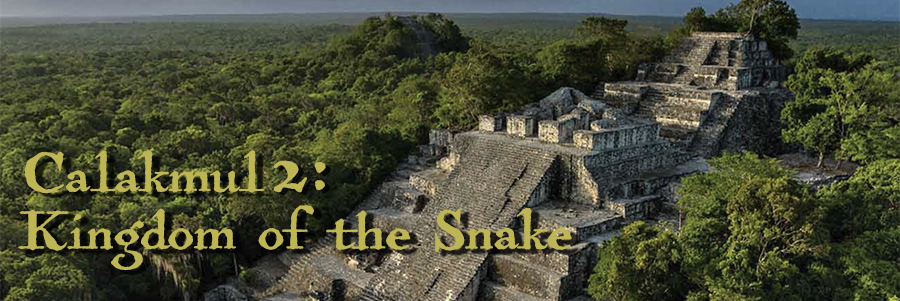
If you missed the earlier newsletter in the Calakmul series or the El Mirador series, they are available online in our Insights Archive.
Travels of the Snake Kings
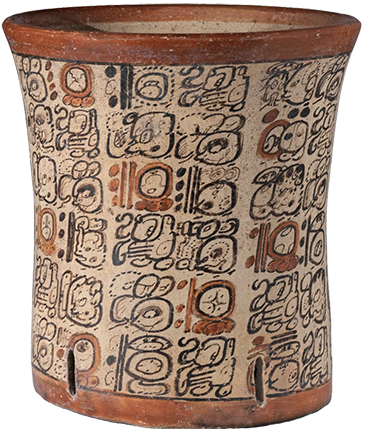
The Snake Dynasty is thought to have originated in the Preclassic Mirador Basin, later migrating to Dzibanché after the collapse of the Mirador agricultural system, and eventually resettling in Calakmul, where it achieved its greatest power and influence. The Dynastic Vase shown on the left records a list of fourteen Snake Kings, each with the Snake emblem glyph and their investiture date.
David Stuart, in his new book The Four Heavens: A New History of the Ancient Maya, argues that emblem glyphs specified royal dynasties rather than geographical locations—dynasties which could and did move to different geographical locations over time. Stuart believes these Maya royal families, and particularly the Kaanul “Snake Kings”, were highly related to each other through intermarriage yet engaged in perpetual fratricidal “Game of Thrones” politics, the intricacies of which Stuart lays out in his detailed and compelling narrative.
David Stuart, The Four Heavens: A New History of the Ancient Maya, Princeton University Press, 2026, p. 108
In this newsletter, we skip the patiently reconstructed history of the Dzibanché years to focus exclusively on the reigns of the three most influential Snake Kings after their relocation to Calakmul: Yuknoom the Great, who brought the Kaanul dynasty to Calakmul, reigned for fifty years, and was the most powerful of all Maya overlord kings; his son Yuknoom Yich’aak K’ahk’ (Fiery Jaguar Paw), the first Snake King born at Calakmul who, after a brilliant career as warrior and hegemon, suffered humiliating defeat at the hand of arch-enemy Tikal and endured the quick decline of his influence and ability to project power; and grandson Yuknoom Took’ K’awil, who attempted to restore Calakmul’s prestige by a ferocious building and urban redesign campaign within the city.
The Hegemony of the Snake
The Kaanul dynasty, both before and after its arrival at Calakmul, operated not as a centralized empire in the modern sense, but as a hegemonic superpower. Their authority was maintained through a complex system of “over-kingship” relationships where local rulers retained their thrones but owed their political—and physical—survival to the Snake Kings.
- The Snake Kings, most notably Yuknoom the Great, claimed the title of Kaloomte’. While a standard ruler was a K’uhul Ajaw (Holy Lord), a Kaloomte’ was an overlord who held the power to “seat” or “install” other kings. In the Maya political landscape, the “overlord” Calakmul provided military protection, prestige, and access to its vast trade networks, while the vassal cities (such as La Corona, El Perú-Waka’, Dos Pilas, Naranjo, Caracol and others) acknowledged the Snake Kings as their superior.
- The Snake Kings utilized proxy wars to weaken their primary rival, Tikal. When Calakmul defeated a city, they rarely occupied it. Instead, they installed a loyalist on the throne—often a local noble who had been “sponsored” by the Kaanul court.
- Simon Martin notes that major military strikes (often timed to celestial events) were designed to decapitate the leadership of Tikal’s allies, forcing those cities to switch their affiliations to the Kaanul overlords to avoid total destruction. The Snake King’s name would appear on the vassal’s monuments, stating that the local ruler acted “under the supervision” or “by the authority” of the Kaanul Kaloomte’.
- Much of the conflict with Tikal may have been a strategic plan to control long-distance trade routes by surrounding it with a network of vassal kings loyal to the Kaanuls, which we discuss next.
The Flow of Patan (Tribute)
The ultimate goal of this overlord-kingship scheme was the extraction of patan—tribute as well as the lucrative tariffs that control of trade routes conferred. This was the economic lifeblood that allowed Yuknoom the Great to build his great Chiik Nahb marketplace and the massive palatial complexes of his redesigned Structure II.
- Food Staples: The surrounding Petén lowlands fed the non-farming elite and specialists of Calakmul, as Calakmul’s hydraulically engineered “convex” water system was designed to provide for human consumption and building construction needs (stucco) but all evidence suggests that the canals, aguadas, and reservoirs were not used for agriculture.
- Utilitarian necessities: Salt was needed from the seawater evaporation pans in northern Yucatan and along the Belize coast, Highland Guatemala provided obsidian for cutting and scraping tools, and finished granite manos & metates for grinding corn were imported from the Maya Mountains in Belize.
- Luxury Goods: Jade was imported from the Motagua River Delta on the Caribbean, Highland Guatemala provided feathers & obsidian for ritual use, and the Pacific Coast was the source of cacao. Luxury goods were used for royal gifting to bind vassal states into the network.
- Human Labor: Allied polities provided the labor force for architectural renovations and monument building, as well as for infrastructure maintenance (reservoirs, elevated causeway systems, canals, etc.)
Trade Routes
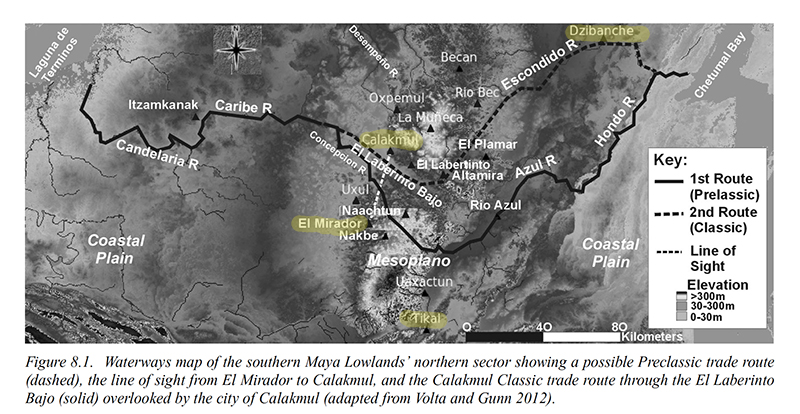
Gunn, Joel D and Folan, William J., Calakmul: Agent Risk and Sustainability in the Western Maya Lowlands, ARCHEOLOGICAL PAPERS OF THE AMERICAN ANTHROPOLOGICAL ASSOCIATION, Vol. 24, pp. 101–123
The most important trade routes crossed the Yucatan Peninsula in an west/east direction, connecting Laguna de Terminos on the Gulf of Mexico (west) to Chetumal Bay on the Caribbean Sea (east). Significantly, both Dzibanché, where the Kaanuls initially settled after leaving the Mirador Basin, and Calakmul, where a branch of the Kaanuls moved in 636 AD, are both located along the dotted “Classic” northern trade route as seen on the map.
Dzibanché is located in a region of rich soils and good water retention capable of producing the agricultural surpluses needed to support a bureaucracy large enough to control trade and the military. It also overlooks the northeastern part of this trade route fed by seagoing canoes along the Caribbean coast which were used to transport of salt and jade.
In contrast, Calakmul was a less desirable location for agriculture but a strategic location for controlling the lucrative Candelaria River and El Laberinto Bajo sections of the western trade route. This trade route was vital for long distance trade destined for the Petén interior because it utilized rivers enhanced with portages, artificial canals, and tow paths, thus facilitating transport by canoe—critical in a civilization without the use of wheeled vehicles or beasts of burden. With its network of tribute-paying vassal states and its ability to tax goods flowing through a major cross-peninsular trade route, Calakmul garnered the wealth needed to become the major Maya superstate of its time.
As David Stuart argues in The Four Heavens, this tribute was a redistribution system—the Snake Kings took from the periphery and moved wealth into the capital, creating the artificial prosperity that made Calakmul the most attractive and powerful city in the Maya world during the 7th century.
Funerary mask of Yuknoom Ch’een II (Yuknoom the Great)
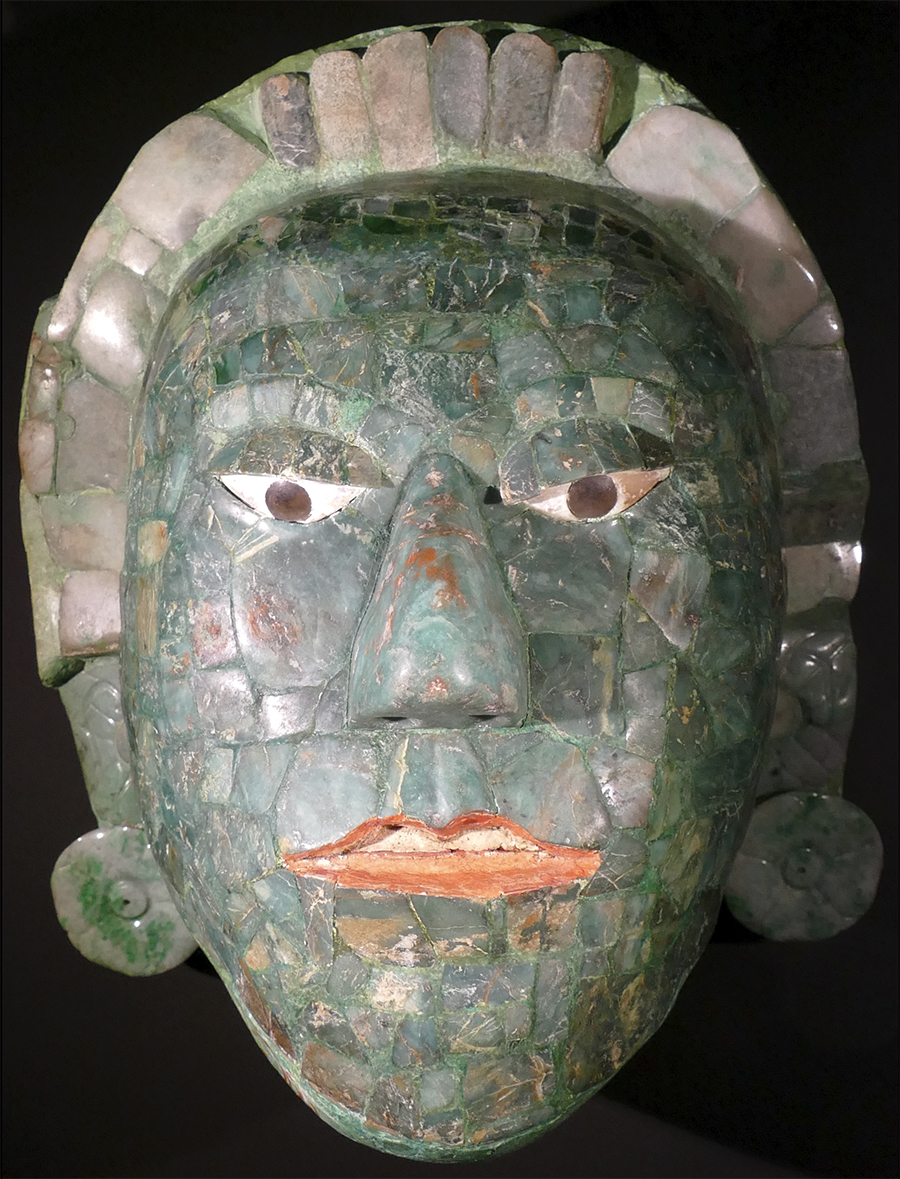
Funerary jade mask, contains an inscription that identifies it as the image of Yuknoom Ch'een II. Museo Arqueológico Maya, Fuerte de San Miguel, Campeche, MEXICO. Photo by Bernard DUPONT, Used under Creative Commons CC BY license
The Move to Calakmul (630 AD)
The relocation of the Kaanuls to Calakmul marked their transition from a regional power to a continental superpower. We begin with Yuknoom the Great, ruler of Calakmul for fifty years during Calakmul’s “Golden Age” (636 AD to 686 AD). Under his long reign, Calakmul reached its zenith, managing a vast network of vassal states and effectively strangling Tikal, its arch-enemy. Because of pressure from the Snake Kings during both the Dzibanché and Calakmul phases, Tikal was kept in a perpetual “hiatus” with no monumental buildings, stelae or inscriptions raised from ~562 AD to 692 AD. In 677, Yuknoom the Great, working in conjunction with his vassel states Dos Pilas & Cancuén, managed a reinforcing victory over Tikal. David Stuart cites Yuknoom the Great as perhaps the most impactful ruler and powerful power broker of the entire Maya Classic Period. Stuart writes:
Not long after he formally established the court at Calakmul in 635, Yuknomch’en [Yuknoom the Great] oversaw the construction of the city’s old E Group. At its center, amid the market stalls, was constructed a small, beautifully painted pyramid with staircases facing out toward each of the four world directions, the same four heavens of cosmos and politics. In so doing, he established the market and its pyramid structures as a central place, much like an E Group of the Middle Preclassic period.
At Calakmul, the cosmological structure probably symbolized the city’s new role as a true “center,” a magnet for commerce and trade within the Kaanul realm. The painting on the outer walls of the pyramid, revealed in excavations in the early 2000s, are unlike anything ever seen in ancient Maya art or archaeology, with scene after scene of commercial activity with people eating, drinking, selling, buying, and conversing. Different vignettes show different commodities: corn drinks, tamales, salt, ceramic wares, incense, and more. Clearly the pyramid’s colorfully decorated sides, like mirrors, reflected the activities once taking place around it.
David Stuart, The Four Heavens: A New History of the Ancient Maya, Princeton University Press, 2026, p. 184
The Chiik Nahb Market Pyramid
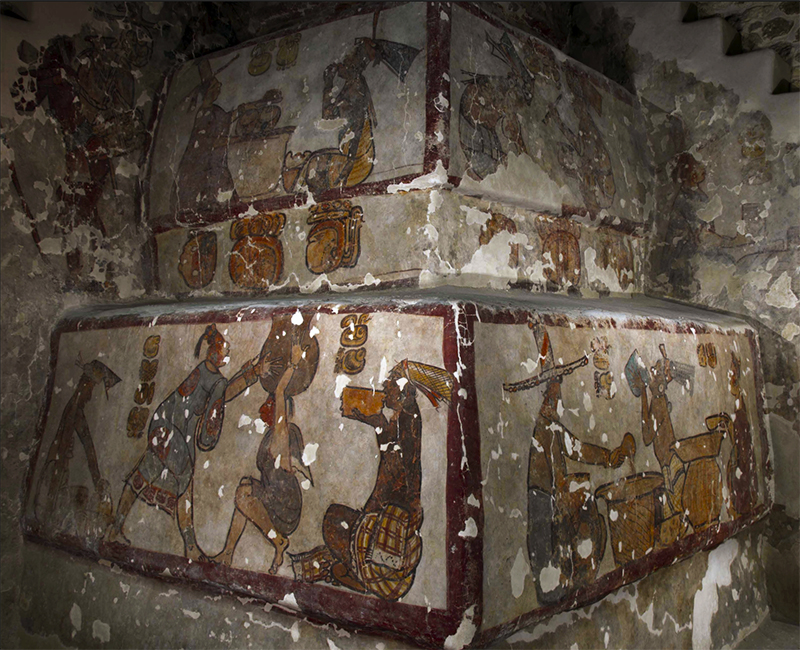
Ramón Carrasco Vargas, María Cordeiro Baqueiro, The Murals of Chiik Nahb Structure Sub 1-4, Calakmul, Mexico. In Maya Archaeology 2, edited by Charles Golden, Stephen Houston, and Joel Skidmore, pp. 8-59. Precolumbia Mesoweb Press, San Francisco, 2012.
The Commoners
The Chiik Nahb murals give us a rare glimpse of the common people during the height of Calakmul’s ascendency. Women wore the distinctive Calakmul hats while men sported cloth head wrappings, and all wore beautiful textiles. David Stuart mentions the woman in the elegant blue dress, who appears to be supervising activities of the market and who appears in several panels of the murals, and wonders if she might even be a wife of Yuknoom Chen. Please take a moment to enjoy more photos of these remarkable murals!
The Merchant/Traders
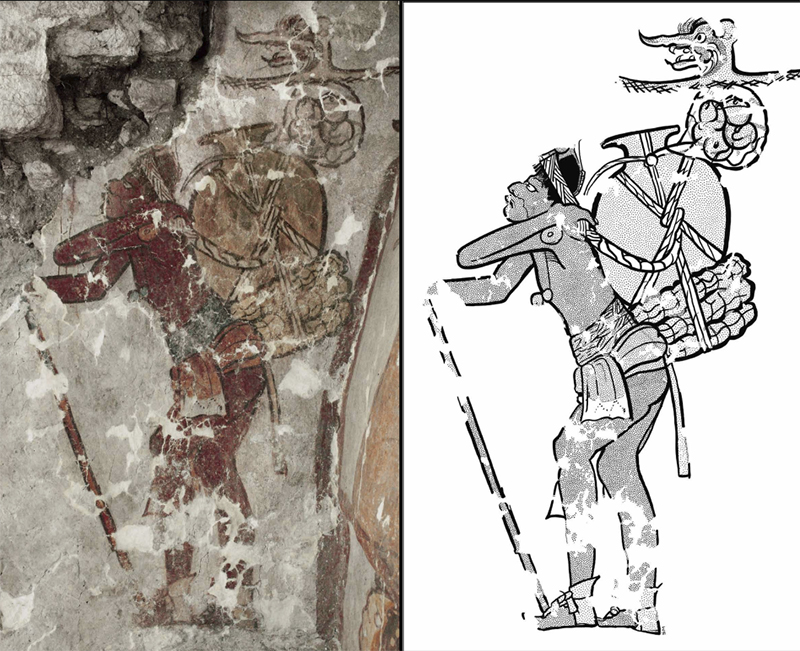
The Maya had no beasts of burden nor did they use the wheel, so goods had to be transported overland by human bearers unless part of the journey could be done by canoe. Salt was imported from the salt flats of the Yucatan, traveling first by sea-going canoes and then carried to the interior cities of Petén. Jadeite from the Motagua River trade routes far to the south also came by sea-going canoe which eventually connected to the overland east-west trade routes and their ultimate markets. Obsidian from the volcanic highlands of Guatemala far to the southwest was needed for cutting tools and ritual objects and arrived via the Usamacinta/Calendaleria portion of the trade routes from the west.
Simon Martin imagines the sacbé [networks of raised causeways linking major cities] not only as a trade network for the exchange of goods, but also for the interchange of intellectual, artistic & cultural ideas, and imagines the color and chaos of such a network:
There would be tribute-bearers loaded with cloth, cacao, and still more precious items, passing jobbing porters burdened with sundry commodities, including pine torchwood and salt brought from afar. They would be joined by merchants specializing in high-value exotica and crafted wares, couriers carrying news, messages, and diplomatic gifts, parties on their way to nuptial ceremonies, pilgrims en route to sacred sites, and little doubt itinerant healers, bards, and troupes of actors and musicians into the bargain. From time to time roads would clear of ordinary travellers to let pass bands of adrenaline-fueled warriors trying to outpace news of their advance. At less frenzied moments, the same thoroughfares saw the stately progress of noble emissaries, princes, and kings, borne on elaborate litters with a suitable entourage of bodyguards, retainers, and accompanying baggage-trains.
All this traffic would produce a mixing of people and ideas, but the key travellers for our concerns would be the bearers of learning: the itz’aat, ajtz’ihb, taaj, and ajk’in, the scholars, scribes, artists, astrologers, and priestly keepers of the calendar. It was primarily through them, and the books they carried, that cultural knowledge and intellectual developments would have been disseminated, crossing not only political but linguistic boundaries, to reach the furthest corners of the Maya realm.
Simon Martin, “Ancient Maya Politics: A Political Anthropology of the Classic Period 150-900 CE”, Cambridge University Press, 2020, p. 306
Marriage Diplomacy
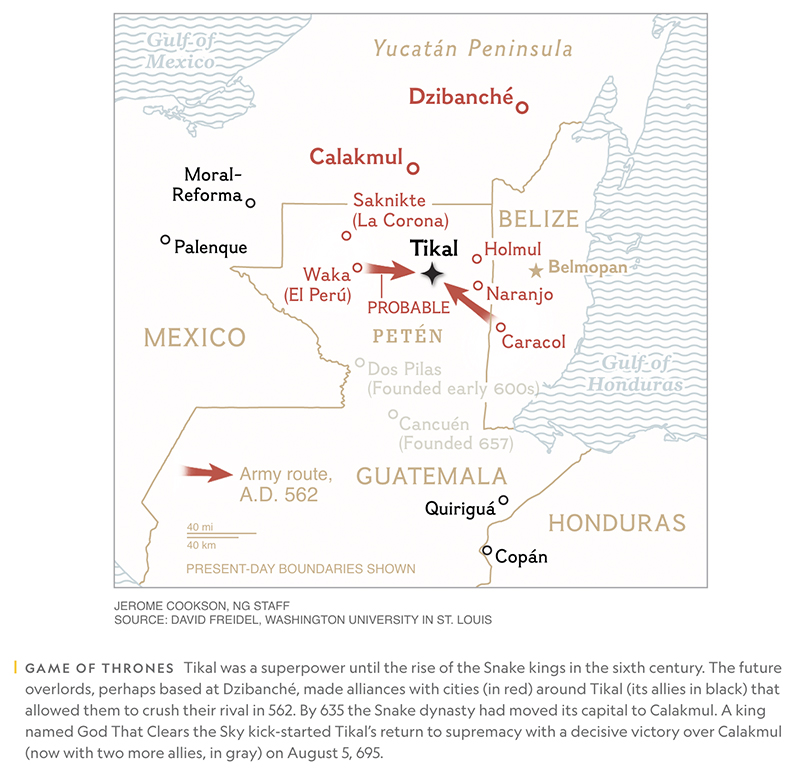
https://www.nationalgeographic.com/magazine/article/maya-empire-snake-kings-dynasty-mesoamerica
It appears the Snake Kings had an appetite for empire from the beginning. The map shows their alliances, with cities overseen by Dzibanché/Calakmul in red and states allied with Tikal in black. In addition to military conquest, the royal princesses of Calakmul were established as “Stranger Queens” in Calakmul’s subordinate kingdoms to tighten their bonds to these vassal cities. For example, Lady K’abel, daughter of Yuknoom the Great, married the king of Waka’ (El Peru), thereby securing an observation post and launching area for attacks on Tikal. Daughters of Calakmul’s vassal kings also could and did play this role, as exemplified by Lady Six Sky, a Dos Pilas princess who was sent to Naranjo and became a noted warrior after producing an heir to the kingdom.The stelae erected by these women make clear their differential in status and power compared to their husbands.
In Maya texts, scholars have identified around 35 women from a variety of ruling families who wed outside their dynastic group, yet the Kaanul seem to have prioritized and benefited from this strategy more than others. Indeed, two of the most powerful Maya women known, Lady K’abel and Lady Six Sky, were stranger queens in service of the Kaanul.
But once a stranger queen fulfilled the duties expected of her as a woman, she was able to assume privileges and powers that were typically restricted to men in Classic Maya society. These women dressed in masculine garb, waged wars, played power politics, and commissioned monuments touting their achievements.
Bridget Alex, Jungle Realm of the Snake Queens: How Women Ascended the Ranks in the Highstakes World of Maya Politics, Archaeology Magazine, Jan-Feb 2023.
It is suggested that Lady Skull-Ik (also known as Lady Evening Star), the mother of Bird Jaguar IV of Yaxchilan, could have been a Calakmul princess, possibly another daughter of Yuknoom the Great. She is commemorated by a stela showing her performing a ritual sacrifice as the ruler of Yaxchilan.
Yuknoom Yich'aak K'ank
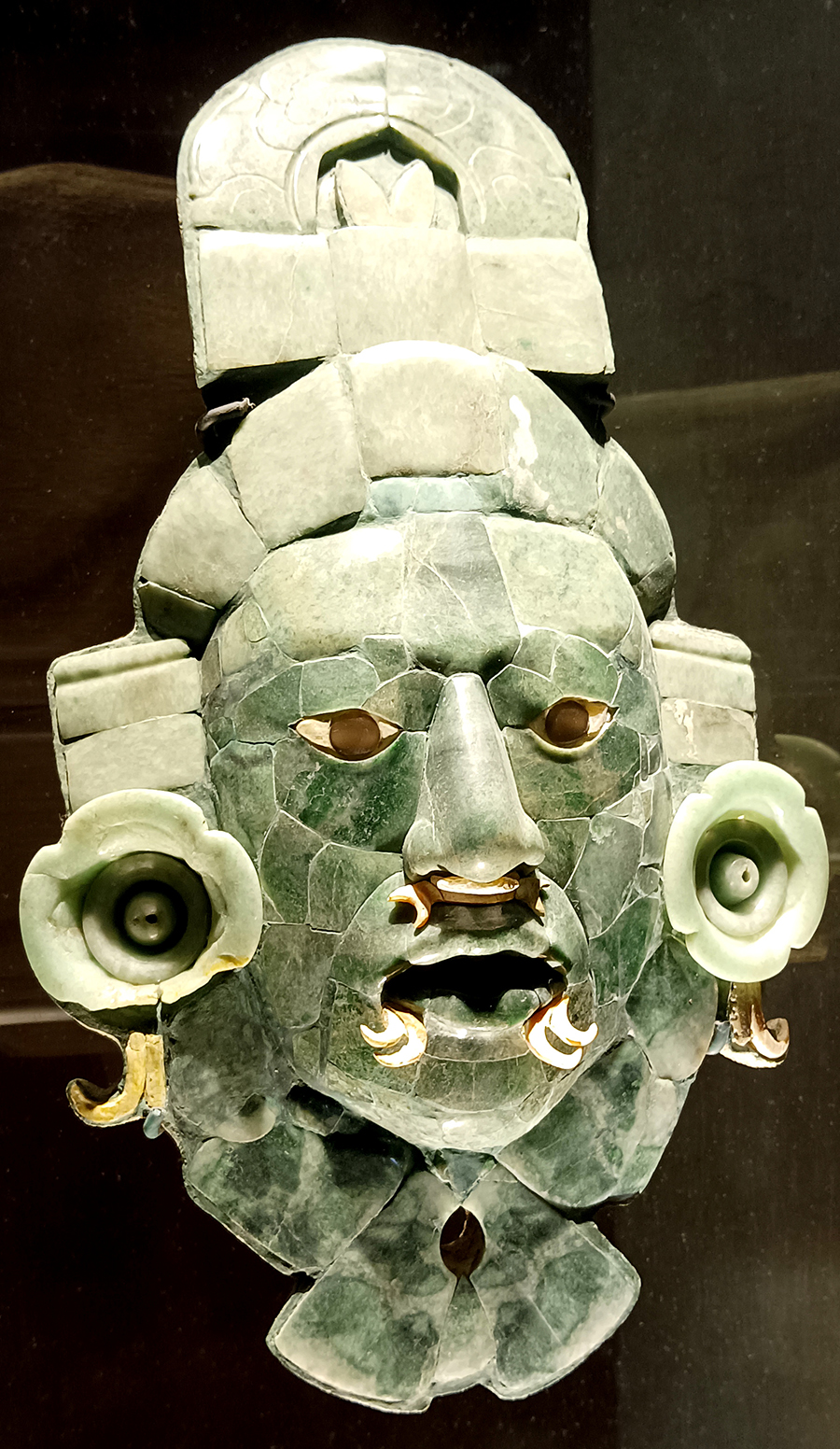
One of a set of 10 masks discovered in 1984 next to the skeletal remains of Yuknoom Yich’aak K’ahk. Found under Structure II in 1984, Museum of Mayan Architecture in Campeche, MX. Photo by Mario E. Fuente Cid, CC BY 4.0
Stela 9 text
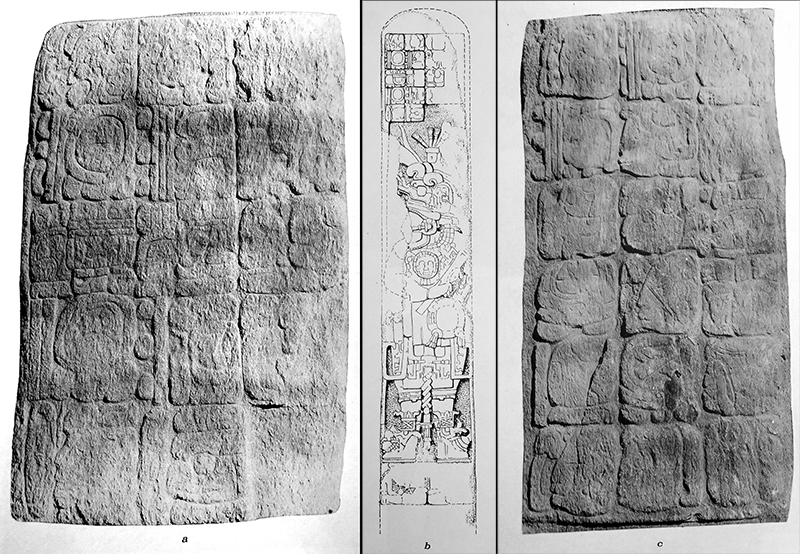
Ruppert & Dennison, Archaeological Reconnaissance in Campeche, Quintana Roo, and Peten,Carnegie Institution of Washington, Washington, D.C., 1943, plate 48 shows Stela 9 drawing of front, plus two glyph panels.
Yuknoom Yich’aak K’ahk’ was the first Snake ruler to be born in Calakmul. Stela 9, erected in the E-Complex, the ceremonial heart of Preclassic Calakmul, recounts his birth. Simon Martin and Nikolai Grube, in Chronicle of the Maya Kings and Queens, write:
It is a great pity that our actual knowledge of him is rather limited. There are signs that he took a leading role in the kingdom well before his official assumption of power. He receives extraordinary prominence on Stela 9, a thin slate stone dating to 662, which carries an extended account of this birth in 649 and ascribes to him a full royal title. Perhaps the aged Yuknoom the Great, ailing or infirm, passed the effective running of the state to the younger man, most likely his son. If so, Yich’aak K’ahk’ should be credited with a major hand in Calakmul’s military and diplomatic successes.
In addition, Yich’aak K’ahk’s authority over Calakmul’s web of vassal states seems as extensive as his father’s. However, in 695 AD, Tikal brought down “the flint and shield” of the Calakmul king, when his army was defeated by Jasaw Chan K'awill of Tikal, who built Temple I at Tikal to celebrate this victory. Martin & Grube continue:
We do know, however, that the humiliation was compounded by the capture of a prominent Calakmul deity called yajaw maan. While its political ambit was far from destroyed, this reverse did bring Calakmul’s golden age to a close. Diplomatic interaction of all kinds fell away sharply in the years that followed, with the greatest effect on explicit statements of overlordship—only one or two such relationships can be identified after this. Hegemony of the kind exercised by Classic Maya powers relied heavily on their military prestige and defeat could quickly undermine their hold over clients and affiliates provoking thoughts of secession.
Martin & Grube, Chronicle of the Maya Kings and queens, Thames & Hudson, London, 2008, p. 110-111
As far as what this victory meant to Tikal, I think Gunn & Folan express it best:
The second engagement at Naachtun between Calakmul and Tikal in C.E. 695 was important, successful for Tikal, and marked the end of the Calakmul Golden Age. An explosion of building in Tikal followed, and a Calakmul official was soon on display as a prisoner of war in Tikal. Subsequent ramping up of building activity at Tikal resulted in most of what is now seen as the accomplished Tikal, the Northern Acropolis in particular. This suggests that after 300 years of on-and-off effort, the forces of Tikal had captured access to the Candelaria gateway [trade route] through Itztamkanak, and thus possessed the wealth to build and control as they might.
Joel D. Gunn et al., Calakmul: Agent Risk and Sustainability in the Western Maya Lowlands
Yuknoom Yich’aak K’ahk’ appears to have survived the battle and was buried deep within Structure II, with a funeral plate declaring him as its owner. The jade mask shown at the beginning of this section was found in this tomb.
Yuknoom Took’ K’awill
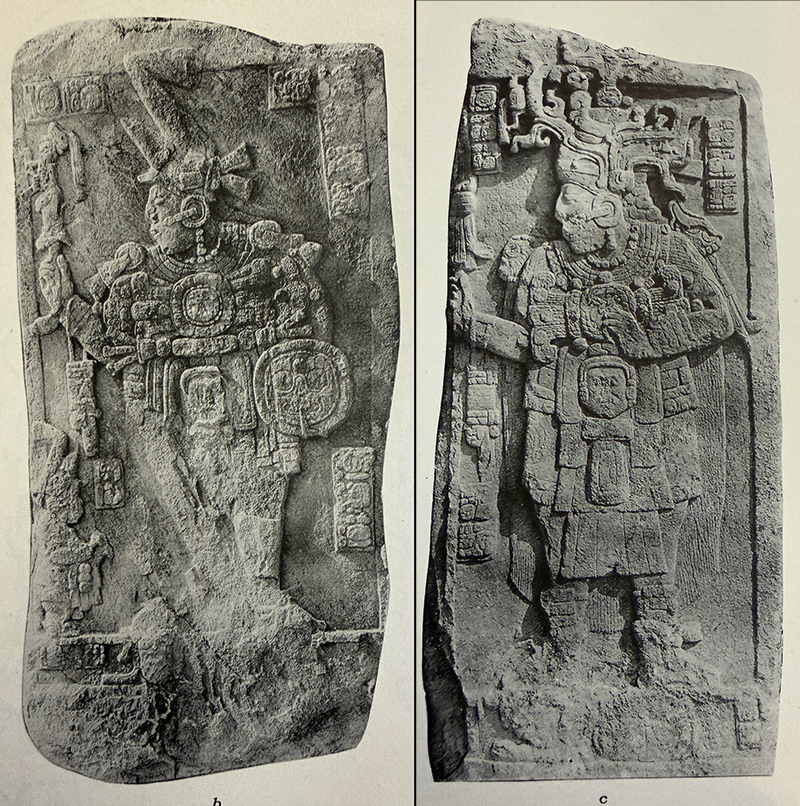
Ruppert and Denison, Archaeological Reconnaissance in Campeche, Quintana Roo and Peten, Carnegie Institution of Washington D.C., 1943, plates 53 (stela 89) and 51(stela 54)
Yuknoom Took’ K’awiil, son of Yuknoom Yich’aak K’ahk’ and grandson of Yuknoom the Great, was the final great builder at Calakmul. His reign was a defiant attempt to restore Calakmul’s prestige. Through an ambitious building program and the commission of numerous stelae, he sought to reclaim the prestige and architectural glory of the Kaanul dynasty’s former heights.
Typical Calakmul stela
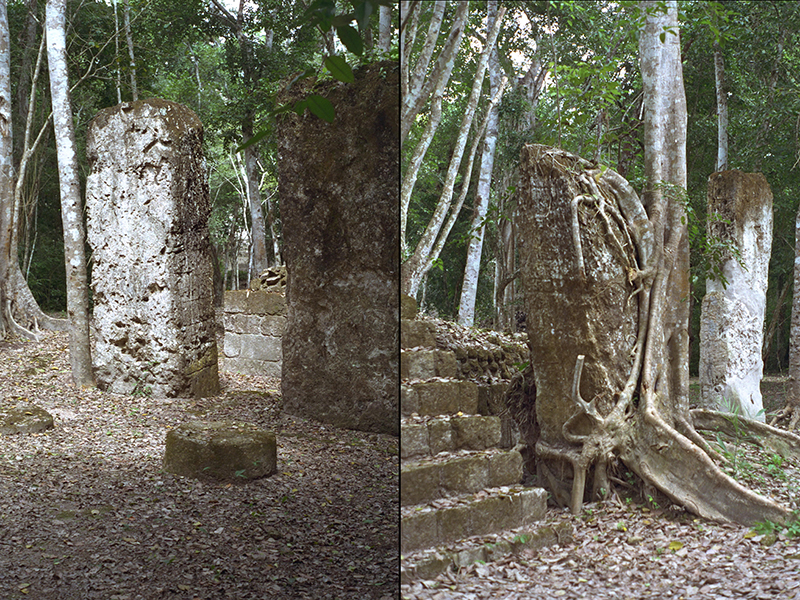
South side of Structure V: Stelae 35 & 36 on left, Stela 34 on right in grip of a strangler fig
Most of what we know about the history and kings of Calakmul comes from inscriptions from other sites because of the poor quality of local limestone and the extremely eroded condition of most monuments at the site. For example, most of the dynastic information recorded on Yuknoom the Great's stelae 34, 35 and 36 is hopelessly undecipherable.
The exception are the stelae that Took’ K’awiil erected at the base and upper levels of Structure I, a large pyramid to the east of the city core, to celebrate the K’atun ending in 731 AD, an important event in the ritual calendar of the Maya. This magnificent set of seven stelae were carved from dense, high quality limestone presumably imported from some distance. During his reign, Took’ K’awiil probably raised at least 21 monoliths at Calakmul.
Even though much influence was lost following his father’s defeat, Took’ K’awiil nevertheless held on to a few of his vassal kingdoms: he supervised the accession of a new ruler in El Perú (date illegible); in 702 he appears at Dos Pilas; and as late as 711 AD, Naranjo’s king boasts of his fealty to Calakmul. And, of course, his 15th Katun ending stelae are the most magnificent of all Calakmul monuments.
In more recent times, however, Took’ K’awiil magnificent Structure I stelae have suffered much indignity at the hands of looters and their chainsaws.
Structure 1 with looted stela
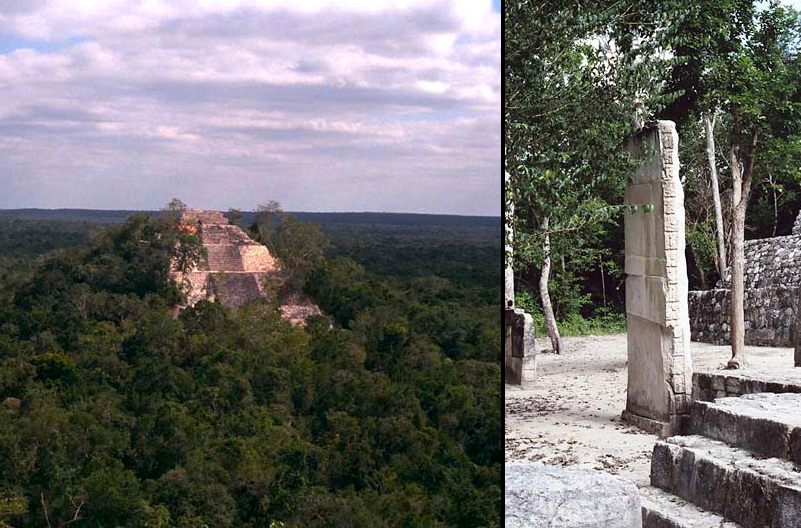
Photos courtesy of Jeff Purcell
More photos and information about Calakmul is available on the MayaRuins website.
Comments? Questions? Let us know at newsletter@mayaruins.com
Our JUN/JUL 2026 Issue, Rió Bec Breaks Free, will examine how the defeat of Yuknoom Yich’aak K’ank and the waning ability of Calakmul to project power and exact tribute freed the Rió Bec agricultural region north of Calakmul to create its own unique political and artistic identity.
NOTE: Visit our ARCHIVE for past newsletters.