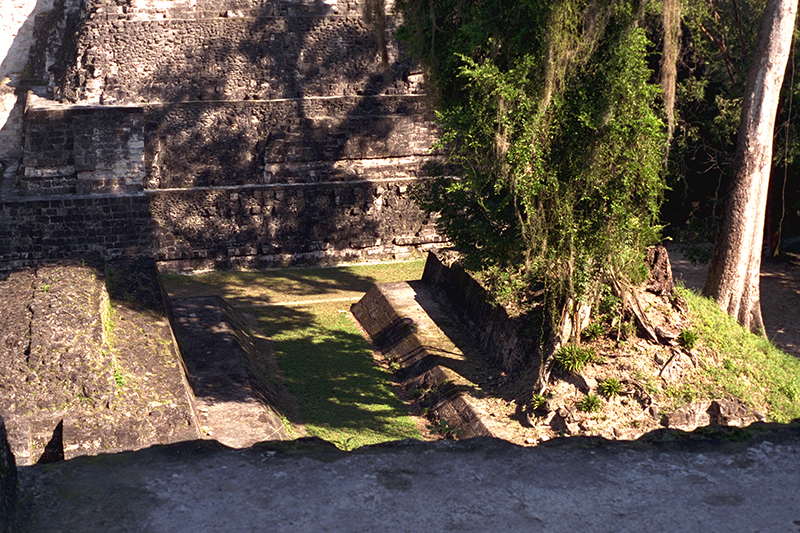
Ballcourt at the edge of the East Plaza
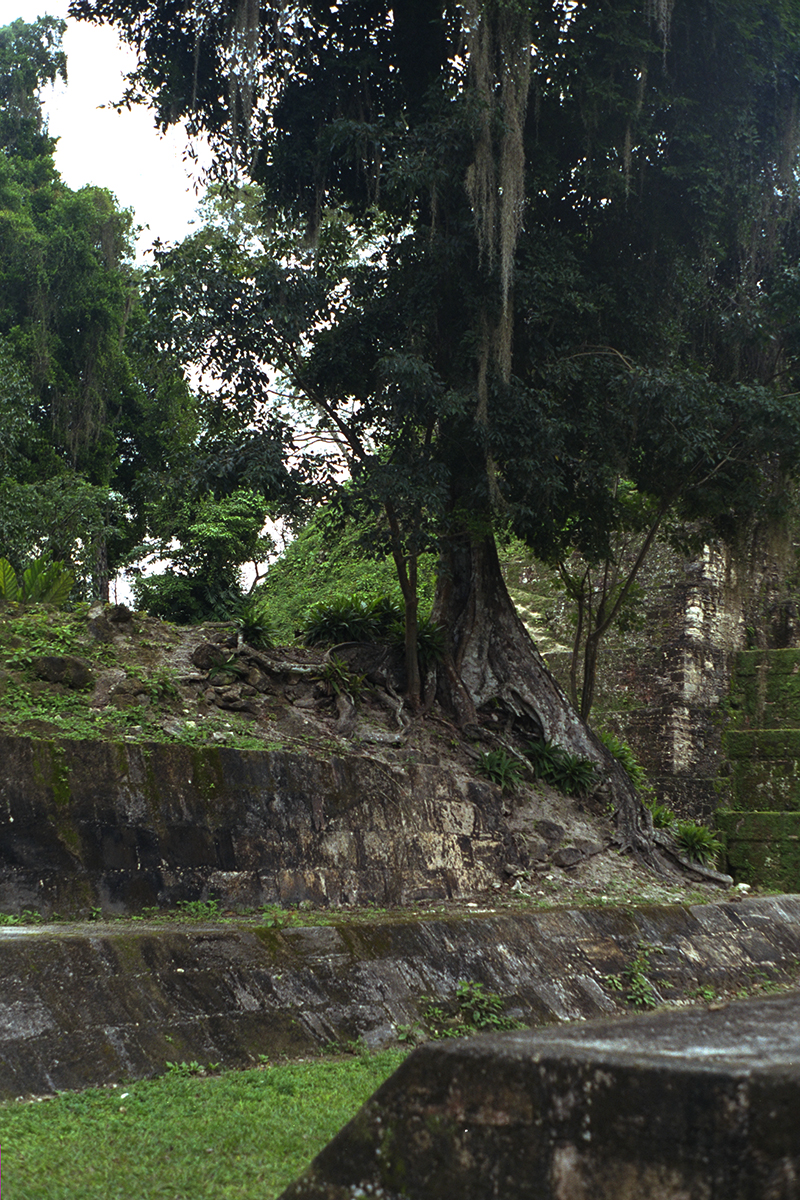
Jasaw Chan K'awiil (682–734), who built Temple I and Temple II as well as Twin-Pyramid Complexes M, N and O, may have also been responsible for replacing the earliest twin-pyramid complex at Tikal with this small ballcourt and its associated Teotihuacan–style temple.
Simon Martin & Nikolai Grube. Chronicle of the Maya Kings and Queens. Thames & Hudson, Second Edition, 2008, p. 46
home : : : map : : : inner-map
Central Acropolis from Ballcourt

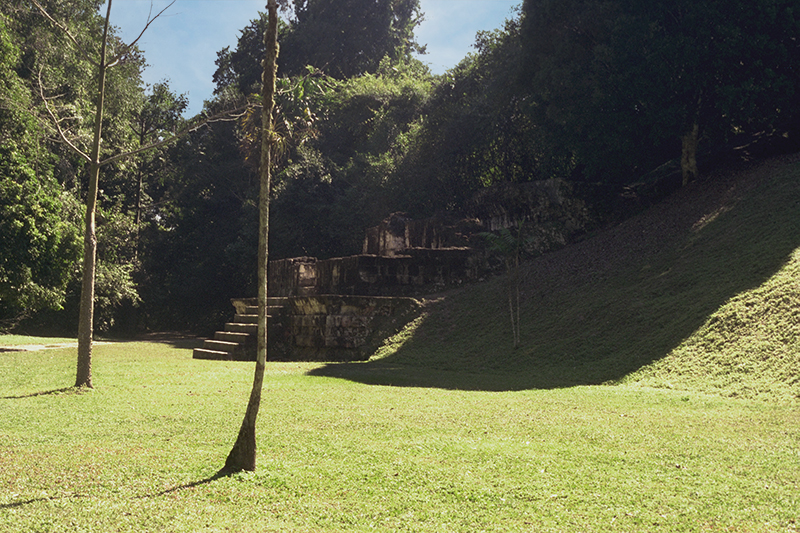
Today the forest at the edge of the East Plaza shrouds the playing alley, leaving the strange little end temple (5D-43) to stand in lonely isolation against the eastern end of the Central Acropolis."
Linda Schele & Peter Mathews, The Code of Kings, p. 70
home : : : map : : : inner-map
Ballcourt from Central Acropolis
home : : : map : : : inner-map
Temple 5D-43 near Ballcourt

Jasaw Chan K'awiil articulated Tikal's revitalization in a very particular way by reviving the symbolism of the once mighty, but now fallen, Teotihuacan. In so doing he evoked direct comparison with the New Order that seized and galvanized the Peten three centuries earlier. His lineage might even represent a literal restoration of this Mexican–derived dynasty.
Simon Martin & Nikolai Grube. Chronicle of the Maya Kings and Queens. Thames & Hudson, Second Edition, 2008, p. 45
The design of the temple shows typical talud-tablero architecture with Teotihuacan decorative elements such as the pairs of circular google–eyes and the feathered fan motif.
home : : : map : : : inner-map
Ancient Graffiti found on temple

Ancient graffiti depicting a ballgame was found in the little temple 5D-43. Schele and Mathews comment on the significance of the ballgame:
In Mesoamerica, the ballgame had a sacred function related directly to the myths of Creation and Origin. The Maize God died and was reborn in the ballcourt. The Maya defined the ballcourt as a crack in the top of a mountain or in the carapace of the Cosmic Turtle, because these were also conceived as rebirth places of the Maize God. People went down this crack to contact their ancestors and consult oracular deities. The Maya and other mesoamericans negotiated and sealed alliances in the ballcourt, and captured kings died by sacrifice in the ballcourt.
Linda Schele & Peter Mathews, The Code of Kings, p. 73
Graffiti shows a game in progress
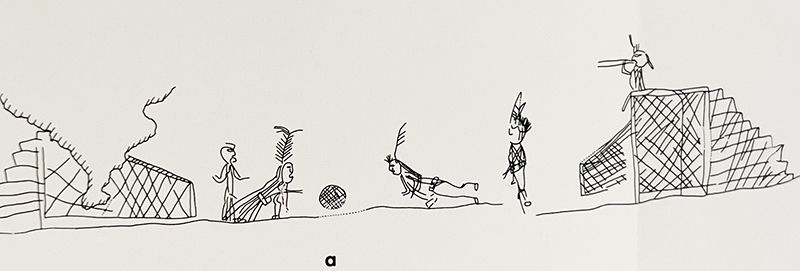
Helen Trick & Michael Kampen. Tikal Report No.31: The Graffiti of Tikal. The University Museum, University of Pennsylvania, 1983. Figure p. 46
Amazingly, a graffiti showing ballplayers engaged in the game was found on the south wall of this building. A musician with a horn accompanies the game from a perch on top of the right playing alley.
Ballplayer equipment included thick yokes to be worn around the waist as protection and to help control the heavy ball. The use of feet was prohibited, which is why two of the players are portrayed in the crouching position of active play.
home : : : map : : : inner-map
The little ballcourt temple
home : : : map : : : inner-map
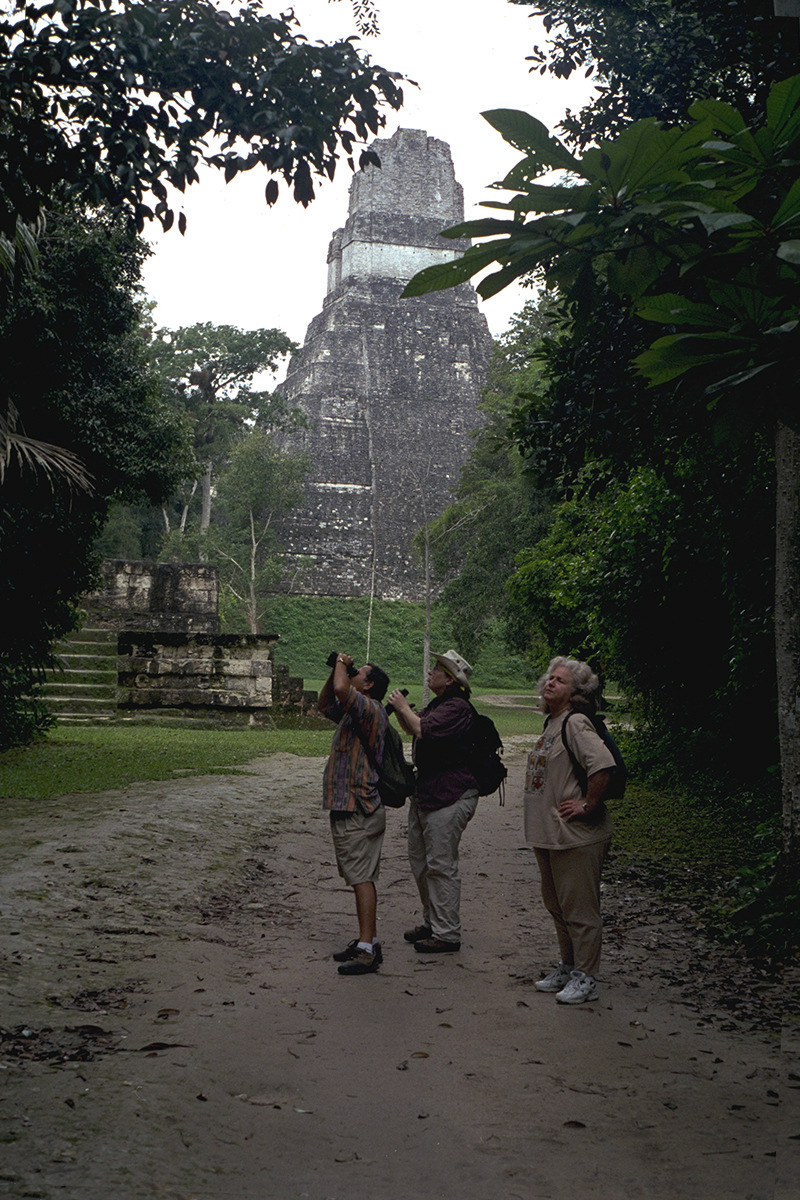
Str. 5D-43 with Temple I behind
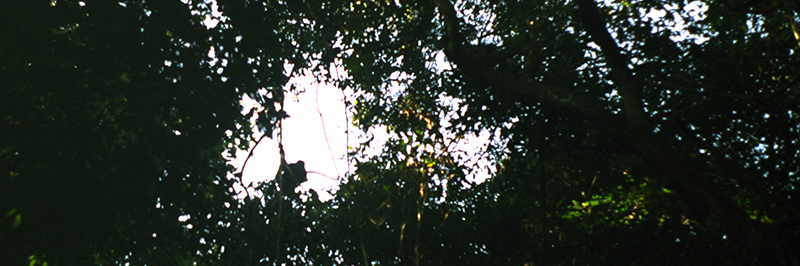
Taking a momentary break from architecture, we look for the howler monkey who watched us from the canopy.