Pier C: Pakal the Great
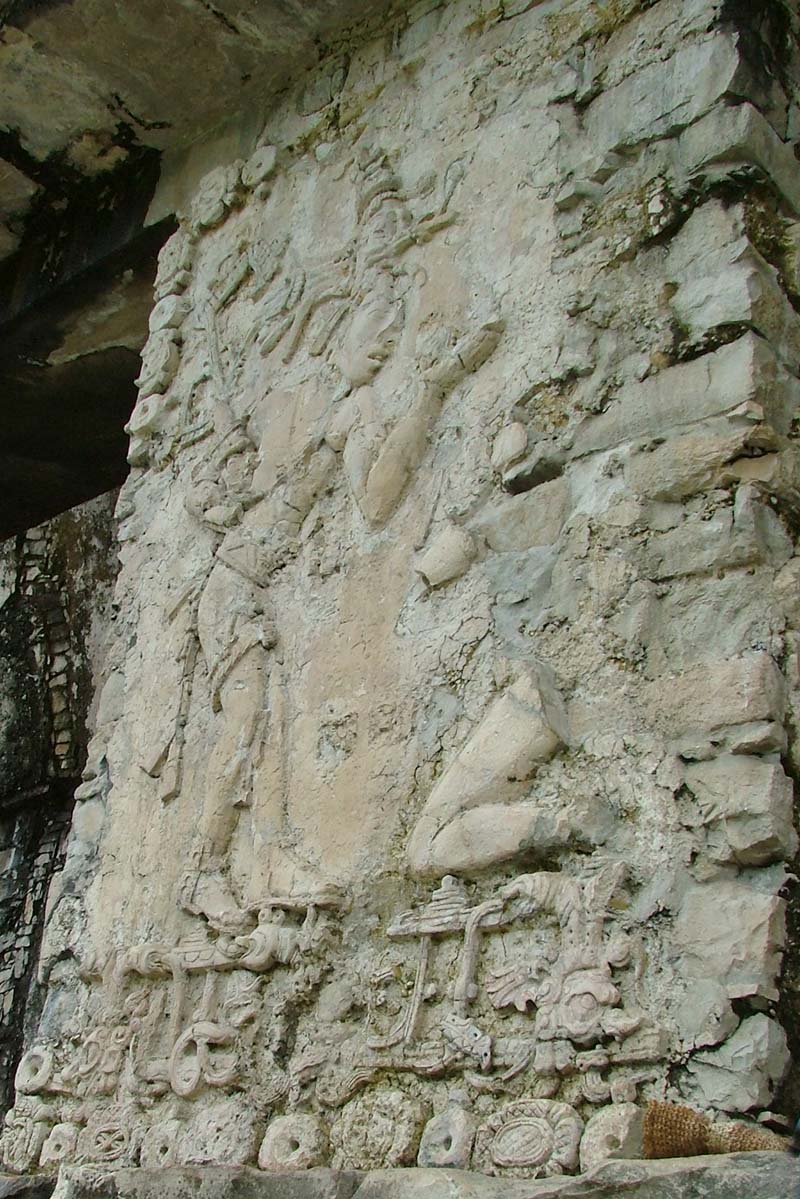
The Stucco-decorated Pier C of the Palace is thought to represent Pakal the Great.
Alfred Maudslay visited Palenque in 1891 for the purpose of photographing and making illustrations of the ruins. One of the tasks in the monumental labor was to clean the stucco modelling on the piers to prepare them for being photographed. This was a work that could not be entrusted to others, as it needed not only great care but also some knowledge of the designs being uncovered.
1890-91: newly cleared Pier C
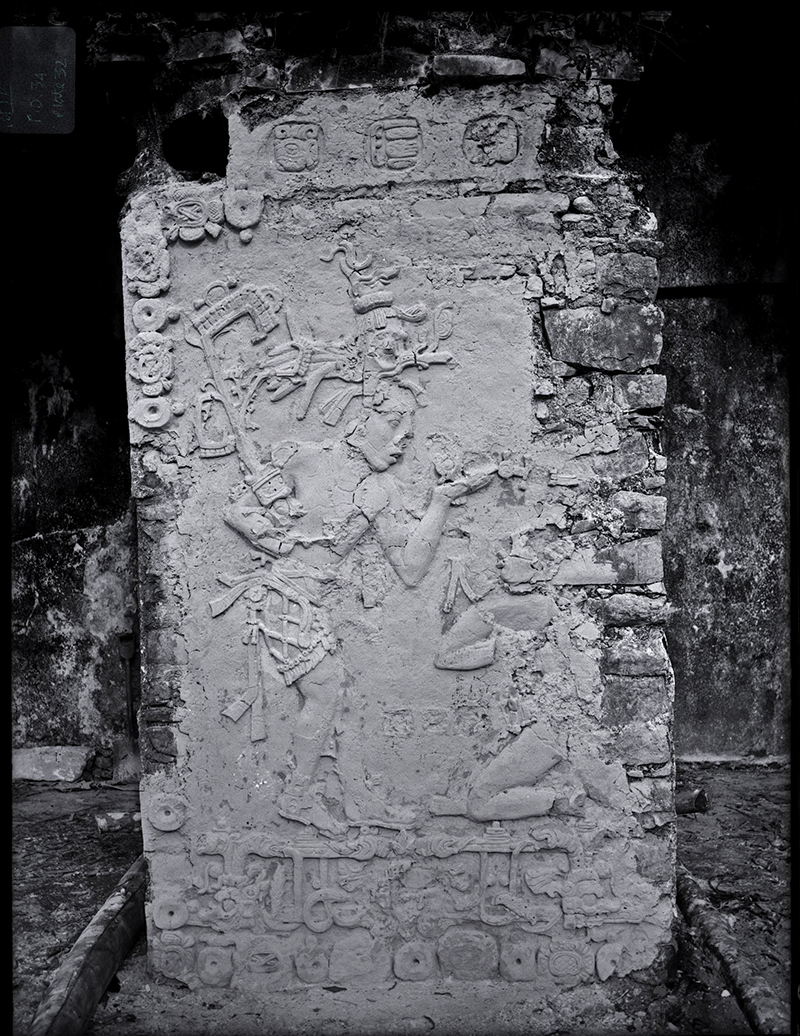
From the Maudslay Collection, British Museum. Used with permission under the CC BY-NC-SA 4.0 non-commercial license. © The Trustees of the British Museum.
The newly cleared Pier C shows detail that is no longer visible today. Ian Graham, Maudslay’s biographer, quotes Maudslay’s diary:
In some instances these decorations have been preserved in a very curious way: the water continually dripping on them from above has passed through the dense mass of decaying vegetation which covers the roofs of the buildings, and has become charged with carbonic acid in the process; it has then filtered through the slabs of which the roof and cornice are built, dissolving some of the limestone on its way, and redepositing it in a stalactitic formation on the face of the piers.
Mr. Price and I worked for some weeks at clearing the carvings of this incrustation, which varied from a hardly perceptible film to five or even six inches in thickness. The thinner parts were the more difficult to deal with, as they were exceedingly hard; where the thickness exceeded two inches a few taps with a hammer would sometimes bring away pieces two or three inches square, and we were fortunate sometimes in finding the colours on the surface of the stucco ornament underneath still fresh and bright.
Graham adds that they found it necessary to wear glasses to protect the eyes from the hard, flint-like particles that flew off at the blow of the chisel.
Progress with the thin incrustations was sometimes so slow that only a few square inches could be cleaned in a day. In other cases the attempt at cleaning had to be given up altogether as the filtration had formed a hard crust whilst the stucco beneath had become disintegrated and soapy, and had no surface left. [But when, in other cases,] the incrustation could be removed in large pieces and the surface of the stucco was sound, we sometimes found the colours with which it had been painted still retaining something of their former brilliancy.
Ian Graham, Alfred Maudslay and the Maya, p. 175-6
Waterlilies, frogs & grotesque faces
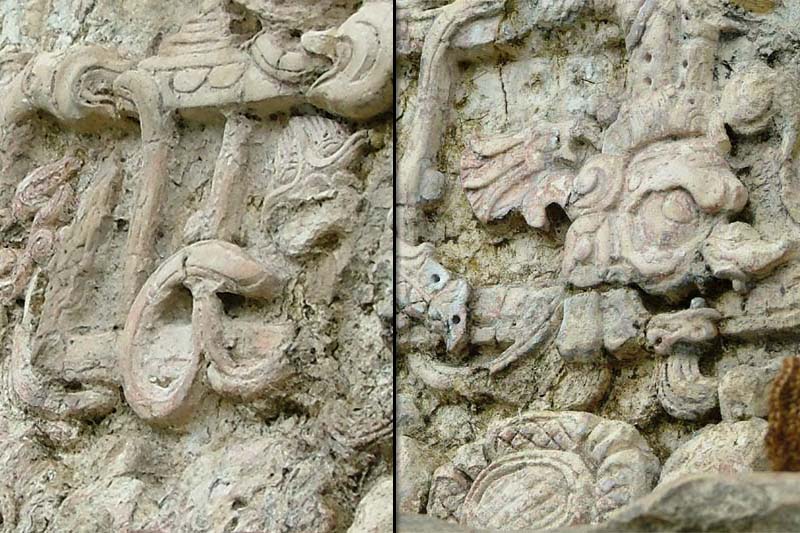
Water-lilies and frogs [left photo] and grotesque faces [right photo] decorate the area under which the king stands. The symbolism of waterlilies was especially important to the ancient Maya. Schele and Miller write:
Raised-field farming was practiced along slow-moving rivers and in swampy areas. Canals were cut between fields and their bottom matter placed on the prepared fields to enrich the soil. Periodically, when the canals were dredged, the bottom detritus was again used to fertilize the fields.
The attributes associated with this type of farming—the chest-deep water, the water-lilies that grew in the canals, the fish that lived in them, the birds that ate both plant and fish and the caiman that ate everything—came to symbolize abundance and the bounty of the earth.
Schele & Miller, The Blood of Kings, p. 11
Pier D: Pakal the Great dancing
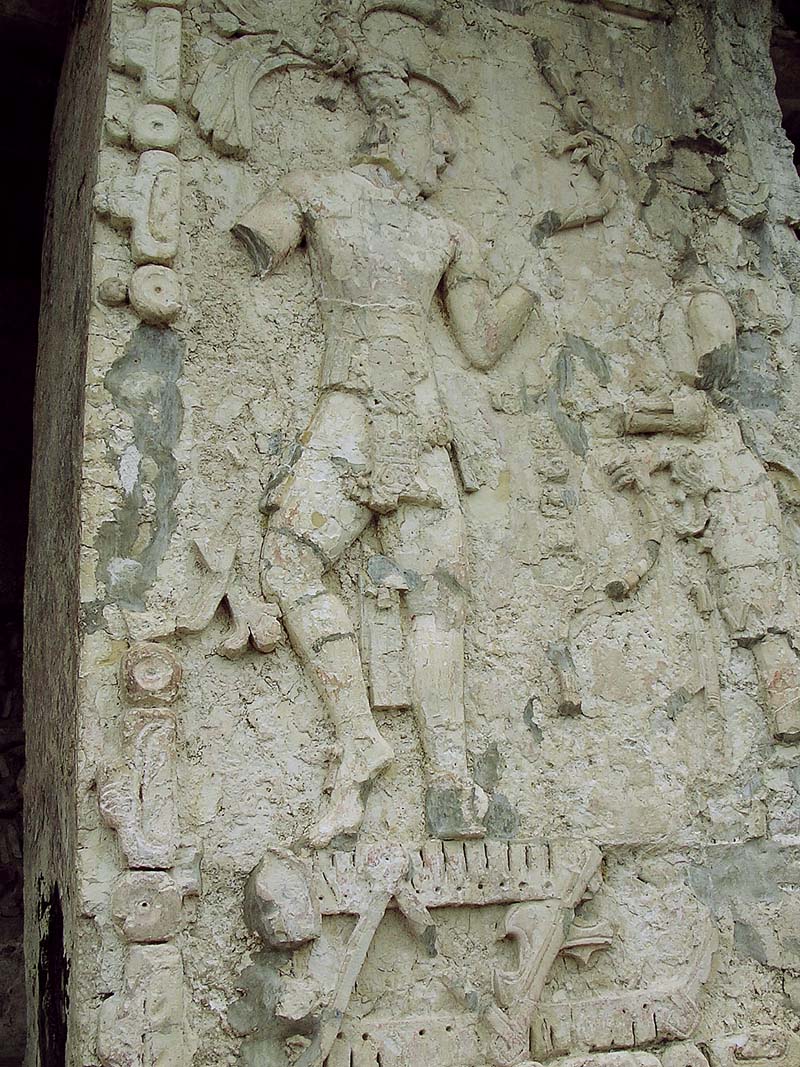
Photo courtesy of Tom Canavan
Pier D of House D of the Palace contains a portrait of Pacal the Great. Freidel & Schele write:
On one of the piers of House D...a male, presumably Pakal, dances with an ax in one hand and a rearing serpent in the other. A second person, perhaps a woman of the king’s family, grasps the lower body of the king’s snake, as it rears upward between them.
Here, however, the dancers wear the costumes of First Father and First Mother, the deities whose actions enabled the final Creation and the birth of all the gods. We presume these figures represent the king and his consort (or perhaps his mother) performing in the guise of the Creator gods. Surrounded by ch’ulel, “holiness,” they dance on a platform marked by a sun-cartouche and point toward the role of dance in the story of Creation.
David Freidel, Linda Schele & Joy Parker, Maya Cosmos: Three Thousand Years on the Shaman’s Path, p. 273-4
Portrait of Pakal on Pier D
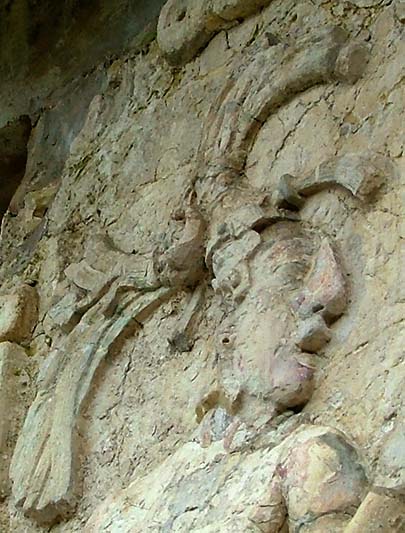
Sculpture on the piers of House D of the palace was even more three-dimensional than on the Temple of the Inscriptions. Pacal’s portrait of Pier D is a fine example. Every detail of this face stands out beautifully modeled. The personified tree in his hair ornament holds a completely three-dimensional flower.
Merle Greene Robertson, Sculpture and Murals of the Usumacinta Region, in MAYA [Palazzo Grassi, Venice 1999] p. 300
Pier F: Pakal’s ancestor, another Pakal

Pier B portrays the First Pacal. This Pacal never ruled Palenque: he died shortly before he would have inherited the throne. This caused the kingship to pass to his daughter on October 22, 612: Lady Zac-Kuk was Pacal the Great’s mother.
One remarkable feature of Palenque is the absence of freestanding sculptured monuments. Rather than appearing on stelae or altars, the portraits of Palenque’s rulers were either carved on stone panels or modeled in plaster, and then placed on the walls of buildings.
Most of these portraits are now fragmentary, but both stone and stucco work were once brightly painted, and many interior walls show traces of these modeled and painted decorations. Fortunately, some of the portraits and most of the hieroglyphic texts carved on stone panels remain largely intact, and these (or skillful casts) can be seen inside several of the site’s most prominent buildings.
Robert Sharer, The Ancient Maya, p. 278
Waterlilies, grotesque heads
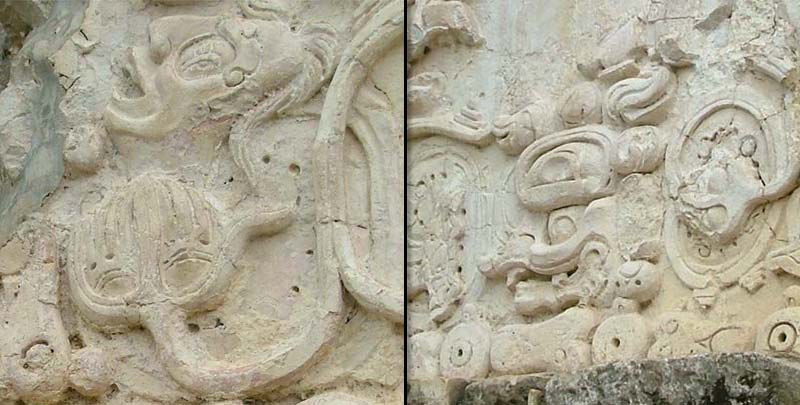
Details of waterlily flowers & leaves plus grotesque heads decorate the piers. A particularly important title of Classic nobility was “people of the waterlily”.
In one primary form, the water-lily is shown as a zoomorphic head, with a mirror or Kan-cross in its forehead [right hand photo]. Rootlike projections emerge from the top and stems, and pads and blossoms rise from the root forms."
Schele & Miller, The Blood of Kings, p. 46