Outward facing side of House A
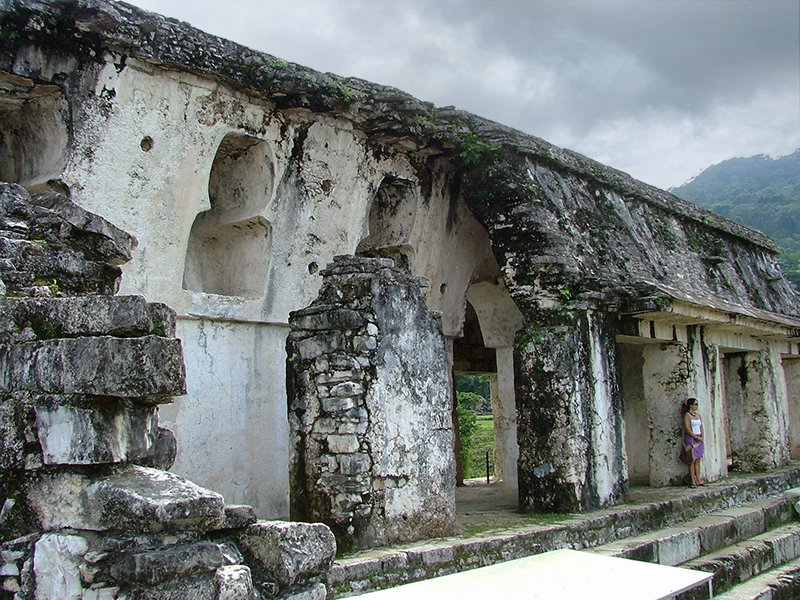
House A was commissioned by Pakal the Great and dedicated in 668 AD
The building stands with its face to the east, and measures two hundred and twenty-eight feet front by one hundred and eighty feet deep. The front contained fourteen doorways, about nine feet wide each, and the intervening piers are between six and seven feet wide.
On the left (in approaching the palace) eight of the piers have fallen down, as has also the corner on the right, and the terrace underneath is cumbered with the ruins. But six piers remain entire, and the rest of the front is open.
Stephens & Catherwood, Incidents of Travel in Central America, Chiapas and Yucatan, p. 310
Pier A once had dedication date
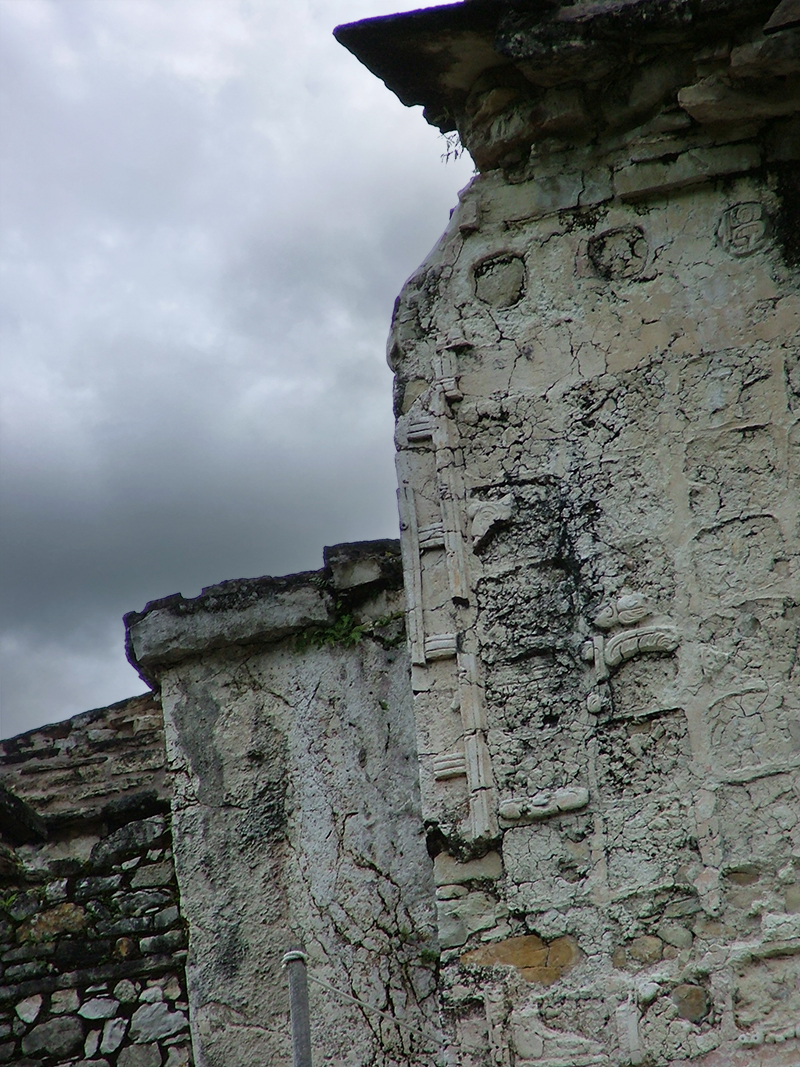
Pier A had originally listed the dedication dates for House A, but in its present condition much of the glyphic text has fallen away.
David Stuart, using Maudslay’s 1891 photograph of Pier A to fill in some of the missing glyphs, “offers a good illustration of how one can utilize a small number of clues to solve what at first might seem a hopeless case.”
Stuart’s short article in Maya Decipherment gives a fascinating glimpse into the world of Maya decipherment.
David Stuart, Reconstructing a Stucco Text from Palenques Palace, July 15, 2014
Outward–facing Pier B
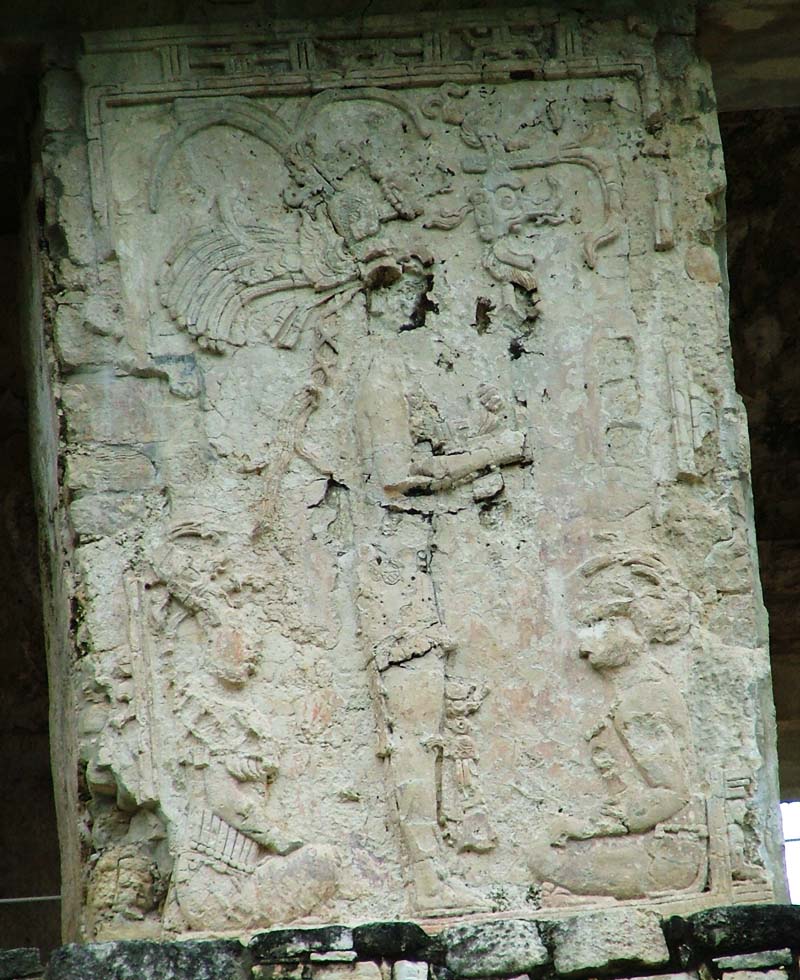
At Palenque, most of the captive or submissive figures are to be found in the northern half of the Palace, the access to which is through House A.
On the piers of the outer facade of House A are modelled in stucco figures of a ruler standing in a majestic pose, holding a lance with the head of God K at the upper end.
At the ruler’ feet are seated two figures, generally simply dressed: on Pier e, these individuals are making the gesture of submission, with a hand resting on the opposite shoulder.
Claude Baudez & Peter Mathews, Capture and Sacrifice at Palenque, p. 5
Unfortunate palace graffiti
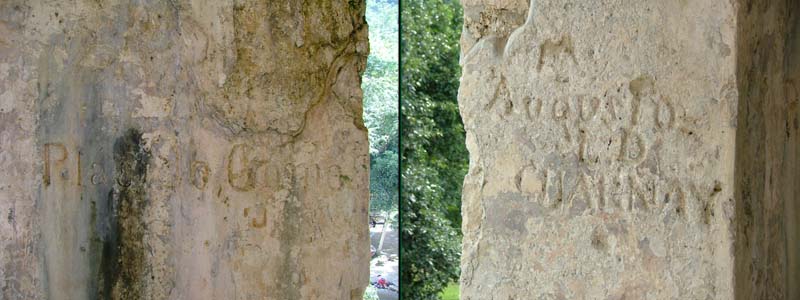
Over the years, the palace has suffered much abuse. On the left, graffiti as left by the Spanish, while on the right, Désiré Charnay, an early French explorer and archaeologist (who should have known better) left his name carved on one of the palace piers.