House C

House C was built by Pakal the Great and dedicated in 661 AD
House C, East Court of the Palace, with House E to the left and Tower behind.
The east court was ornamented with large slabs of coarse limestone carved with subservient figures. One imagines that sacrificial rituals also took place within the Palace; the proximity of accession and sacrificial iconography probably indicates their close relationship in the rites of kingship.
Mary Ellen Miller, The Art of Mesoamerica from Olmec to Aztec, p. 125
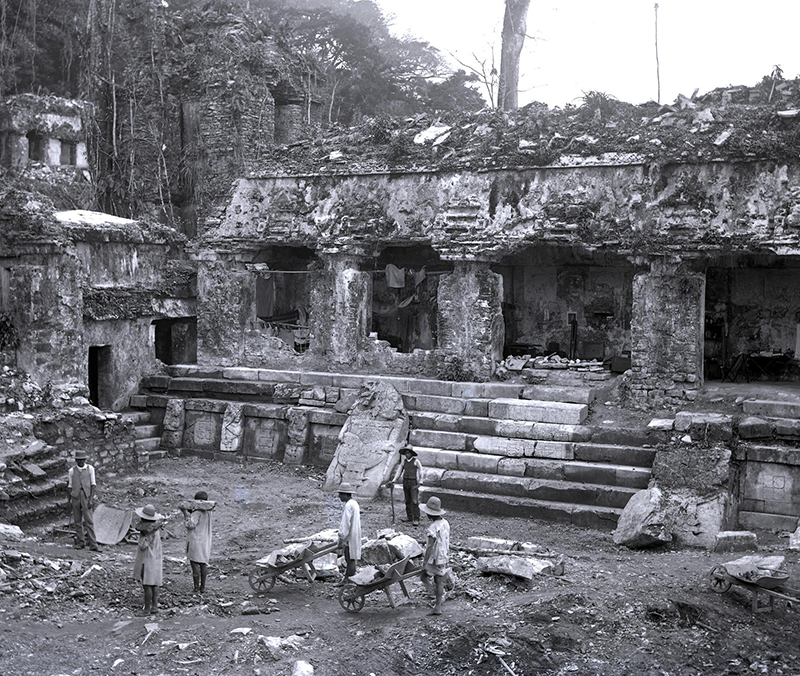
Maudslay’s work crew, 1890-91
From the Maudslay Collection, British Museum. Used with permission under the CC BY-NC-SA 4.0 non-commercial license. © The Trustees of the British Museum.
Maudslay’s work crew at House C in 1890-91. Alot of nice detail of stucco decorations on the mansard roof are visible in this photo. Note the laundry hanging on poles between the piers on the south side of House C. Maudslay actually camped in House C during his stay at Palenque.
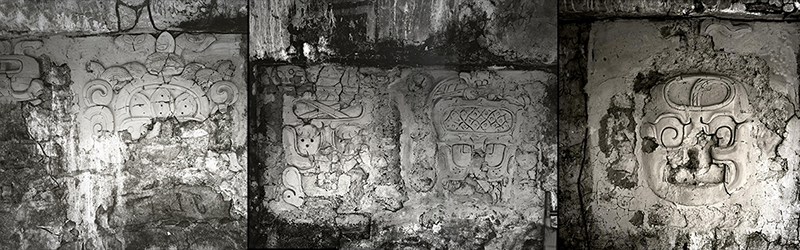
Stucco decoration on back wall
From the Maudslay Collection, British Museum. Used with permission under the CC BY-NC-SA 4.0 non-commercial license. © The Trustees of the British Museum.
Details of stucco decoration that Maudslay found on the back wall of House C. All the palace rooms were decorated with elaborate stucco decoration, but the style of these decorations differed greatly between buildings. Compare, for example, these decorative elements with those inside House B or inside House E.
Hieroglyphic Stairs

Photo courtesy of Marion Canavan
Hieroglyphic Stairs (cordoned off) of House C & Captive Slabs:
The stairway, which bears a hieroglyphic text, has for balustrades two huge sculptured slabs depicting a kneeling figure. Both look similar in style to the slabs on the base of Structure A and may have been added independently and later than the other six figures which adorn the Structure C platform.
The six figures are carved on rectangular slabs which project slightly from the wall and are separated from one another by short texts.
The sculptures seem to form a homogenous group, very distinct from the collection on Structure A. There is the same number (three) of slabs on both sides of the stairway. They are all of the same size and seem well integrated with the substructure’s architecture, which includes a cornice, a tablero and a basal molding.
Besides, all the figures drawn in profile are facing the stairway; they are kneeling, and make a gesture of submission: one of them has the arms crossed on the chest, the other five have one hand resting on the opposite shoulder. The only anomaly in their costume are the ribbons which hang from their ears. Here again we have clear examples of submissive people, whose fate is to be sacrificed.
Claude F. Baudez & Peter Mathews, Capture and Sacrifice at Palenque, p. 8, 11.
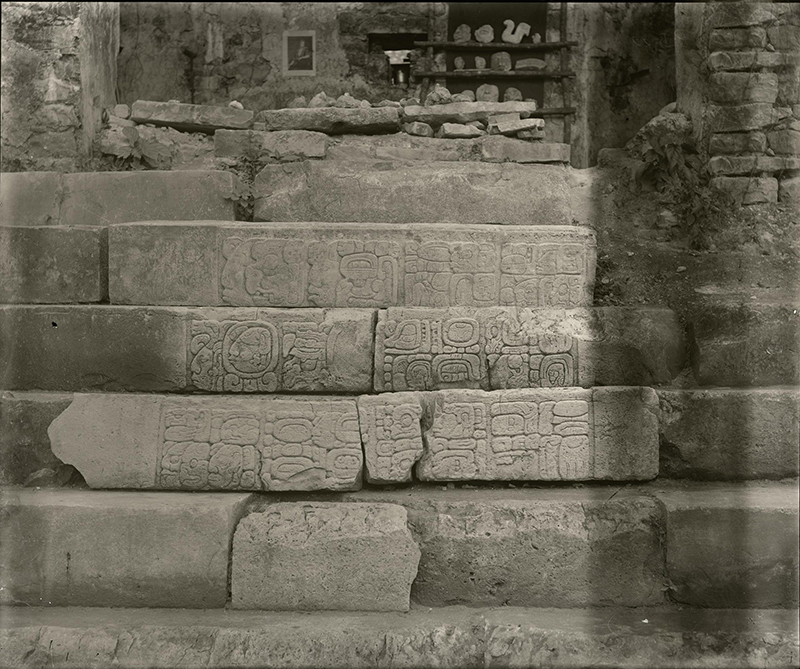
1891 photo of stair glyphs
From the Maudslay Collection, British Museum. Used with permission under the CC BY-NC-SA 4.0 non-commercial license. © The Trustees of the British Museum.
Pakal the Great is the main protagonist in the inscription. He is cited at the beginning along with the dates of his birth and his accession, and again at the end where he is called Mah k’ina Pakal of Palenque. Names of rulers of Calakmul and Yaxchilan are cited as well as the date 7 Chuen 4 Ch'en when the six captives were sacrificed.
Captive Slabs & Glyphic Text

Melancholy Contemplation of an Unfortunate Captive.
Figures left of stair
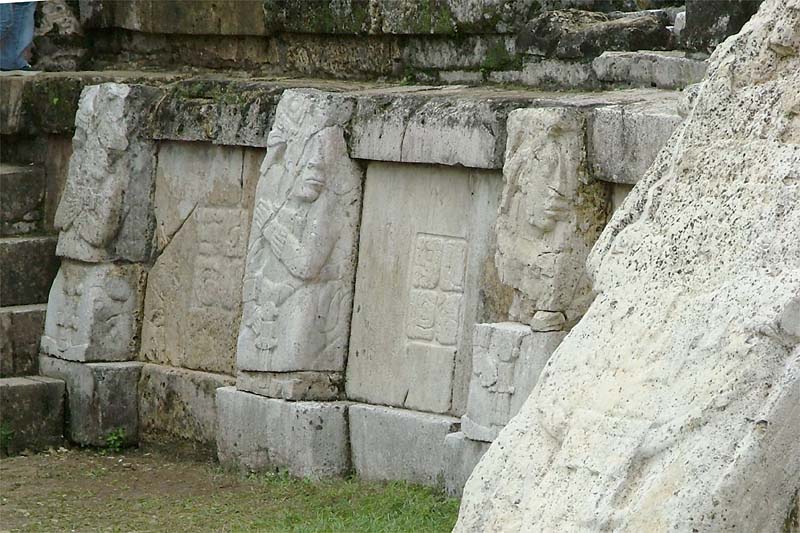
The surviving House C figures wear a pectoral with an eroded day sign and the number seven. The Hieroglyphic Stairway records the sacrifice of six captives on the day 7 Chuwen. The kneeling figures on the substructure of House C represent these six sacrificed lords. The day worn by the balustrade figure on the Hieroglyphic stairs surely refers to this 7 Chuwen sacrifice.
One balustrade figure on the Temple of the Inscriptions wears the number six over a day sign, while the other has a thirteen and a day sign. It happens that the sacrifice mentioned in House C was followed six days later by the arrival of Nun-Bak-Chak, the king of Tikal who had recently been forced into exile by Kalak’mul. This memorable visit fell on 13 Kaban. We think that the figures on the balustrades of the Temple of the Inscriptions and House C commemorate these momentous days on their pectorals.
Linda Schele & Peter Mathews, The Code of Kings, p. 101
Figures on right of stair

Captive slabs to the right of the House C hieroglyphic stairway.
Detail of ear ribbons
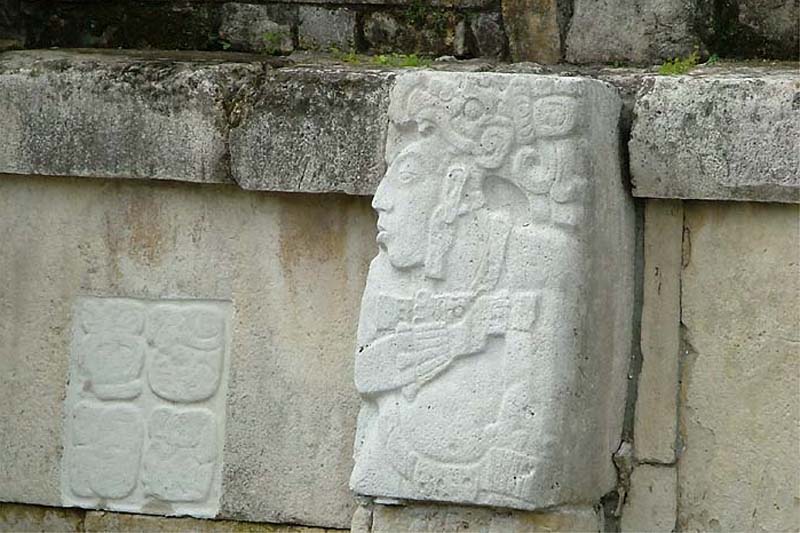
Detail of small prisoner carving with hieroglyphic panel to its left. The crossed-arms-on-the-chest gesture is associated with submissiveness, captivity and death—in a word, sacrifice.
Another characteristic of captives is that they never have customary earplugs but instead wear ribbons threaded through a pierced ear lobe. Baudez & Mathews associate these ribbons with those worn by death deities in the codices: they are usually painted as one or more plain ribbons, or one ribbon with a death’s eye at the end.
Another captive
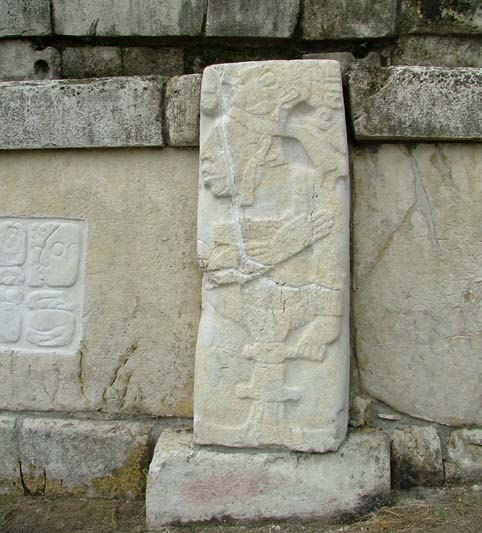
Another captive figure to the right of the stair.
House C & House A-D
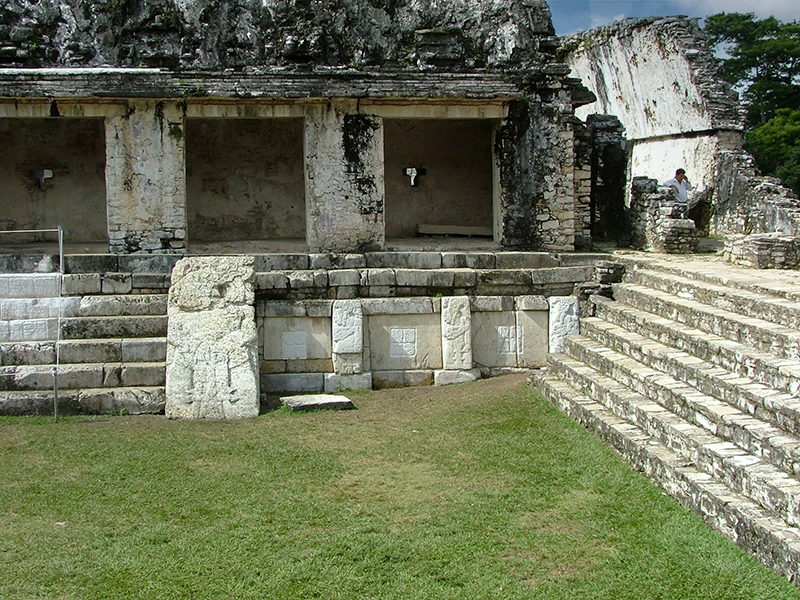
Remains of House A-D, which once ran the entire length of the north side of the palace, is seen on the upper right of the photo.
House A-D was built about 50 years after House C by the unfortunate Kan Xul who assumed the throne after his brother, Chan Bahlam, died. Kan Xul was later captured by Tonina and eventually sacrificed. House A-D housed the Palace Tablet which described Kan Xul’s accession to the throne and is one of the most beautiful tablets discovered at Palenque.