House A, looking north
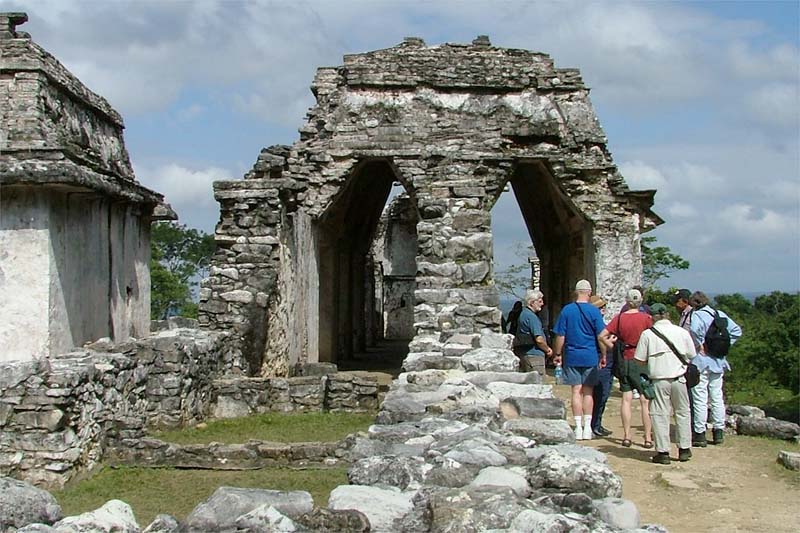
House A was commissioned by Pakal the Great and dedicated in 668 AD
House A with the eastern boundary of the palace on the right and the Eastern Court (Court of the Prisoners) to the left. Note the use of parallel corbeled vaults to create large interior spaces.
Eastern corridor of House A

The Eastern Corridor of House A is decorated with painted stucco medallions, which are placed just above eye-level. Remnants of red paint is still clinging to portions of the stucco work. The archway in the middle of the building leads out into the East Court.
Medallions were ancestor cartouches
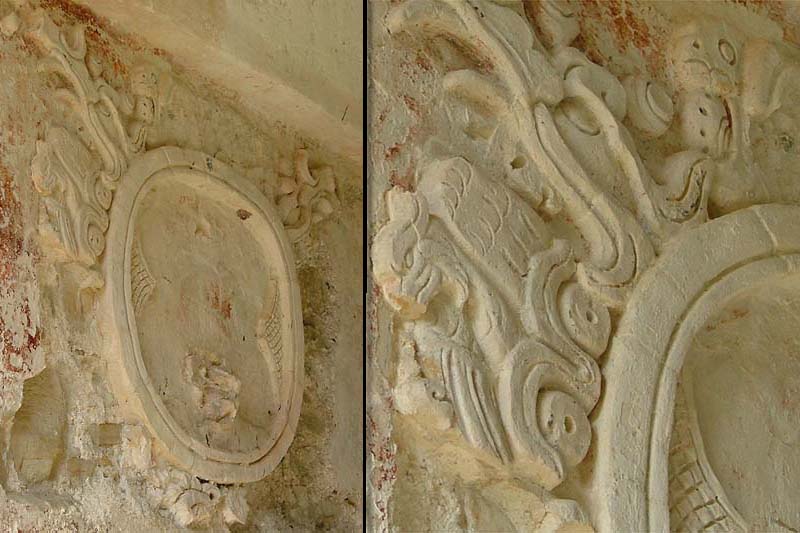
Carolyn Tate writes that large oval cartouches containing portrait busts of ancestors were used at a number of prominent Maya cities, including Palenque, Tikal and Yaxchilan.
Wherever they are found, ancestor cartouches are marked with celestial signs. Here, a bird, possibly a macaw, appears to be rising from the hieroglyph for Venus—the “V” shaped symbol with two circles underneath. Unfortunately, the ancestor portraits have fallen away and only the frames are still visible.
Carolyn E. Tate, Yaxchilan: The Design of a Maya Ceremonial City, p. 59-61