Jaguar Staircase, East Court

A massive stone relief of the Jaguar God's head emerging from the jaws of a Vision Serpent crowns the top of the stairway. Known as the Night Sun, this deity represents the sun (Kinich Ahau) as it travels through the underworld after sunset. He is a supernatural patron of war and sacrifice and is associated with Xbalanque, one of the Hero Twins of the Popol Vuh. The god's attributes include large eyes with scroll pupils, the twisted crueller that rests between them, and the upswept topknot of hair of the Hero Twins.
Night Jaguar is flanked by two giant Venus signs which underscore his association with war and sacrifice, as well as with the first rising of Venus as the morning star, the bringer of the first rains of the agricultural season.
Spiral eyes & twisted crueller

At Copán, the presence of the Jaguar God on the stairway connects the earthly realm to the supernatural power of the underworld and the cyclic nature of time — the cycles of the sun and Venus.
As found & photographed in 1890-91
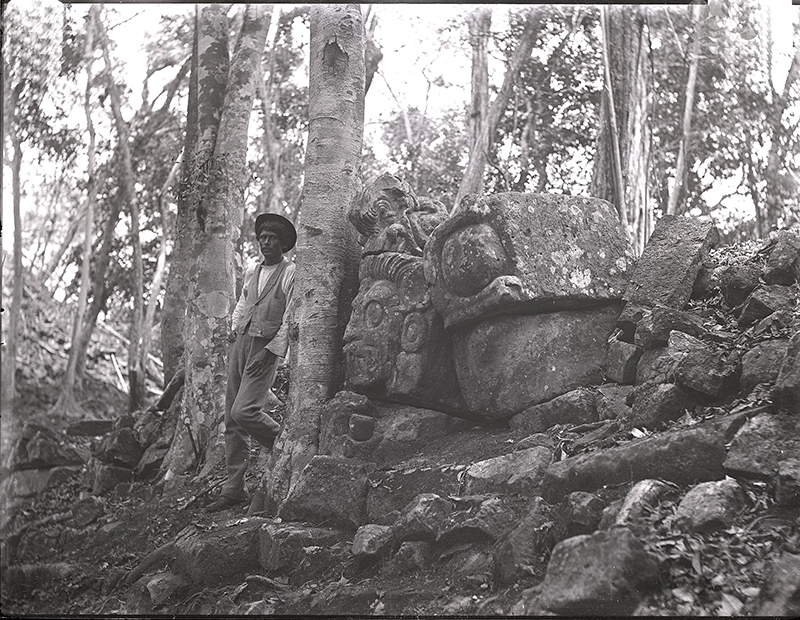
From the Maudslay Collection, British Museum. Used with permission under the CC BY-NC-SA 4.0 non-commercial license. ©The Trustees of the British Museum.
The Jaguar God as Maudslay found him in 1890-91. In this photo, it is easier to see the top jaw of the Vision Serpent from which the head is emerging. To the right is a segment of the giant Venus signs that flank this sculpture.
Dancing Waterlily Jaguars
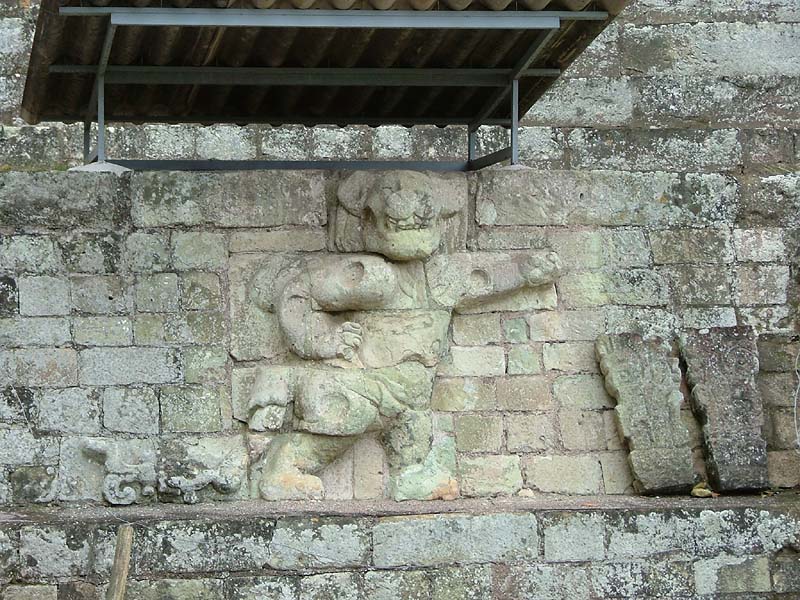
There are two lifesize Waterlily Jaguars flanking the base of the western stairway. They accompany the Jaguar God with dance and are adorned with waterlily flowers and pads. They are often depicted in pottery, and because Maya royalty referred to themselves as "people of the waterlily", they are also thought to have been royal protectors.
According to the Mayanist Linda Schele, the round indentions on the jaguars' bodies were originally rendered with inset obsidian disks to represent spots on their pelts.
The Jaguar as found by Maudslay
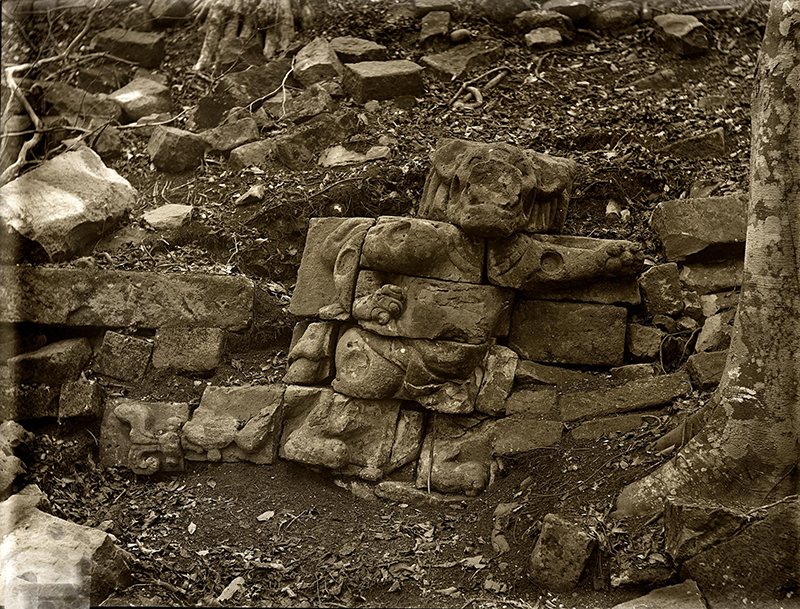
From the Maudslay Collection, British Museum. Used with permission under the CC BY-NC-SA 4.0 non-commercial license. ©The Trustees of the British Museum.
Here is the dancing waterlily jaguar exactly as Maudslay found him in 1890.
The Companion Waterlily Jaguar
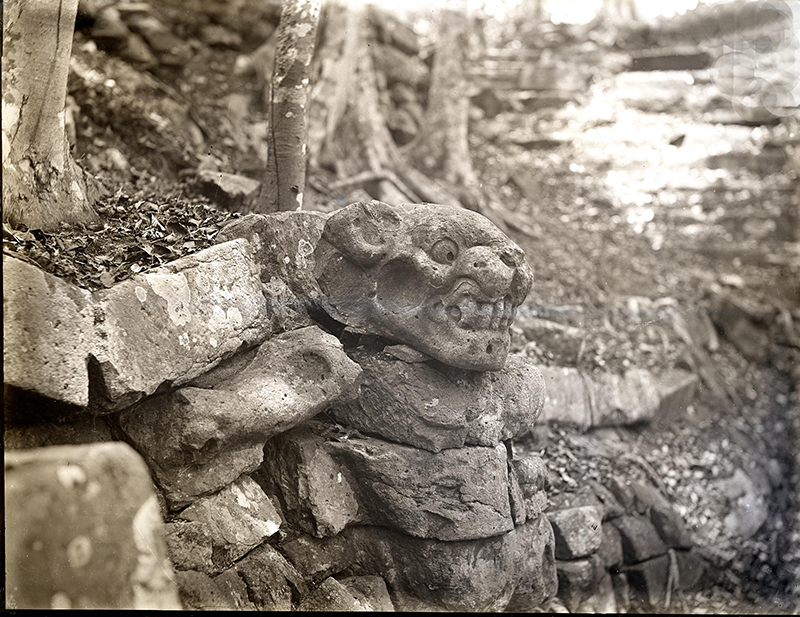
From the Maudslay Collection, British Museum. Used with permission under the CC BY-NC-SA 4.0 non-commercial license. ©The Trustees of the British Museum.
The companion Waterlily Jaguar from the opposite side of the stair is dancing with both arms outstretched, shown here exactly as he was found among the rubble and ruin of the East Court.