
Click here for our annotated Xlapak reading list.
Xlapak is a very small site that is very close to Labná -- so close, in fact, that it may have actually been part of Labná. Its architecture is quintessential Puuc and dates to approximately A.D. 830 to 1000. The photos in this section are exclusively of Structure 1, Group 1 (the so-called "Palace"), which was consolidated and stabilized by INAH (Instituto Nacional de Antropología e Historia de México) in 1965.
Xlapak is located in a flat valley bottom of rich agricultural lands, while in the hills above, the remains of many perishable structures have been found. Thus the ornate and expensive stone buildings of Xlapak were most probably elite residences and the locus of local community & ceremonial activities, while the majority of the population, the commoners who provided agricultural and construction labor, inhabited simpler dwellings in the hills.
There is no indication that the inhabitants of these stone buildings were royal. More probably, they were wealthy elites who managed local affairs while potentially being subordinate to, or integrated within, the sphere of influence dominated by the rulers at Labna and Kabah and overseen by Uxmal.
The north side of Structure 1

Note the raised platform and retaining wall upon which this building rests. This platform is between 1.5 and 3 feet high and probably had a plastered surface.
There are sets of Chac storm god masks in stacks of three on the corners of the upper facade and above the center doorways on the north and south sides. The masks rise above the coping course, which gives them special emphasis.
Joyce Kelly. An Archaeological Guide to Northern Central America: Belize, Guatemala, Honduras, and El Salvador. University of Oklahoma Press. Norman and London 1996, p. 132
Central & Corner Rain God Masks
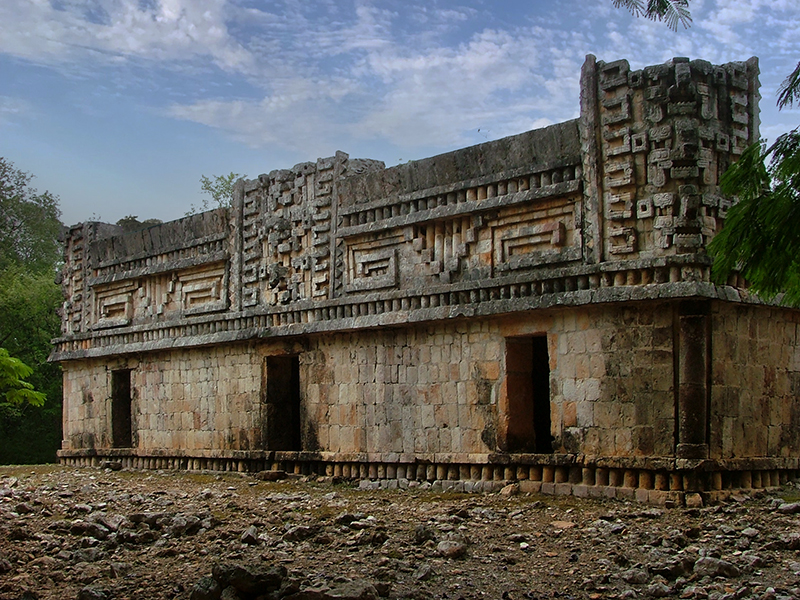
Stacks of Chac masks rise above the central door and decorate building corners.
While the valley setting and the renowned fertility of Puuc soils offered considerable agricultural potential, this was counterbalanced by the region's inherent aridity and the conspicuous absence of natural surface water sources like rivers or cenotes. This juxtaposition of fertile land against chronic water scarcity created a fundamental tension, shaping subsistence strategies, technological innovations, and religious practices.
The extensive evidence of rainwater harvesting systems, such as chultunes (subterranean cisterns), and the pervasive iconographic emphasis on Chaac, the Maya rain god, are direct testaments to the critical importance of water management for survival and prosperity in this environment. These features were not merely cultural embellishments but essential adaptations to the prevailing ecological conditions.
Northeast corner, Str 1

Alternating between the simple and the sophisticated, the "Chac" masks enliven some of the most brilliant architectonic creations of this flourishing phase. A good example of the process of simplification, of extreme "geometrization," which many of these masks underwent then, can be seen on the Palace at Xlapak, where they adorn large ornamental panels that highlight the roof level both at the corners and over the central doors.
Gendrop, Paul. Rio Bec, Chenes, &Puuc Styles in Maya Architecture. Labyrinthos Press. Lancaster, California 1998, p. 180-1
North side central mask stack

The design on the panel above the central door appears to be an identical but flattened version of the mask stack ornamenting the corners of the building (previous photo).
The central mask stack on the north side is quite distinct from the south side stack.
The manifestation of this "pure Puuc" style at Xlapak, a relatively small site, is noteworthy. It suggests that the core architectural canons and iconographic programs, particularly the profound veneration of Chac, were not exclusive to the major political and ceremonial centers of the Puuc region.
Instead, these elements appear to have been widespread, indicating a deeply shared cultural and religious sphere that permeated communities across the Puuc socio-political hierarchy. The ability of a smaller settlement like Xlapak to marshal the resources and specialized knowledge required for such constructions points to a robust and deeply embedded regional tradition, rather than a style solely dictated by elite patrons in the largest capitals.
wind volutes frame central mask

The panels between the central of Chac mask stacks are identical to the panel on the east side of the great Portal Arch at Labná, and similar to motifs seen on the House of the Governor at Uxmal.
The volutes are thought to represent the winds associated with the rain god Chac. They swirl in a counter clockwise direction on the left and a clockwise direction on the right side of the panel.
Chac mask stacks rise above roof

The NW corner displays prominent Chac mask stacks rising above roof level.
The profound reliance of the community on Chac for their sustenance—successful harvests depended entirely on adequate rainfall—is a story written obsessively and repeatedly in stone on buildings at every Puuc site.
South side: courtyard & chultun

A small chultun and its catch basin can be seen in front of the building. A tiny portions of Structure 2 appears in the right foreground
The south side of the building once faced a small courtyard with a chultun.
Pollock noted during his expedition that a large number of chultunes were identified in the area near Structure 1 as well as presumably other places at the site. Chultunes are underground cisterns used in the Yucatan for collecting and storing water for use during the dry season.
Pollock, H.E.D. The Puuc: An Architectural Survey of the Hill Country of Yucatan & Northern Campeche, Mexico. Memoirs of the Peabody Museum 19. Cambridge, Massachusetts. Peabody Museum of Archaeology & Ethnology 1980, p. 60
The presence of chultuns is often taken as an indication of a domestic structure, as opposed to strictly ceremonial structures like temples. Furthermore, the building faces a courtyard defined by Structures 1 & 2. Both buildings were supported by a large platform which was probably covered by a plaster floor. Such platforms typically connected various domestic structures grouped around a courtyard.
central mask stack with difference

The central mask stack on the south side has a quite different design.
The mask stack on the domestic south side features only two masks, compared to the three-mask stacks on the front of the building.
Closeup detail

These features represent the eyes and snout of the rain god Chac.
Structure 1, West Side
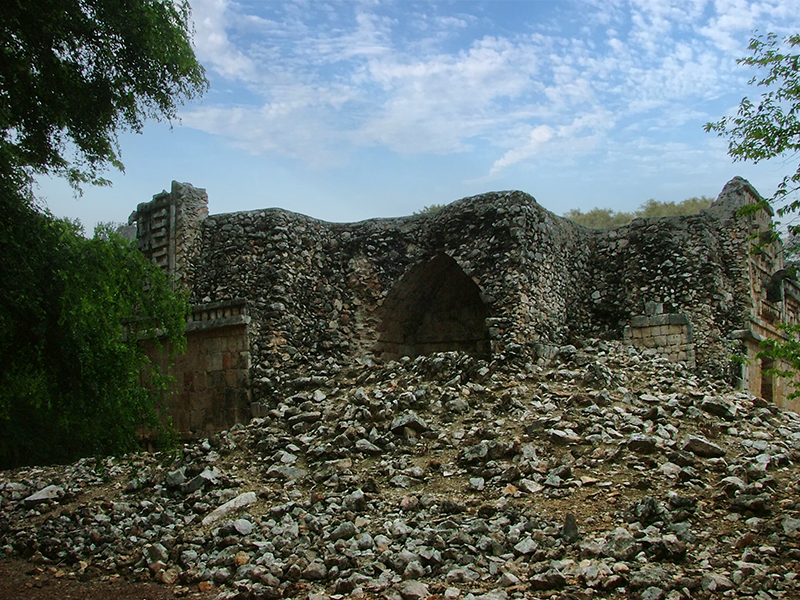
The ruined west side of Structure 1 shows typical Puuc rubble fill construction.
Typical Puuc architecture consists of lower walls finished in plain stone veneer on the lower registers and elaborate stone mosaic work decorating the upper levels. Rooms topped with Mayan arches (without keystones) had thick walls with solid rubble fill.